Harmonised data models are critical for the success of digital maritime services. They are crucial for interoperability between different information systems. They also extend existing systems and support the development of new services. Trends such as Maritime Autonomous Surface Ships (MASS) highlight this need.
S-100 standard
The IHO Universal Hydrographic Data Model S-100 is an ISO 19100-based geospatial standard. It supports various types of data sources.
Data models use S-100 as the framework for representing maritime data. Examples include:
- ENCs (S-101)
- navigational warnings (S-124)
- traffic management information (S-127)
- UKCM data (S-129).
Australian government agencies are also introducing new data models for their services. The Australian Hydrographic Office is working on providing S-101 ENCs and AMSA is trialling S-124 services. We expect other organisations will follow. New data models will support the next generation of data services. These data services will enhance safety and efficiency in the maritime industry.
Australia's first S-100 simulation exercise
- Video transcript
Maritime digitalisation is reshaping shipping — improving safety, efficiency and environmental performance.
At the centre of this shift is S-100, a modern hydrographic data standard that brings charts, warnings, traffic information, under-keel clearance data and more into one harmonised service.
Providing vessels with real-time, integrated data significantly enhances maritime safety by increasing both the accuracy and the speed of information delivery.
In December 2025, AMSA joined the Australian Hydrographic Office and Australia’s leading hydrographic maritime technology and simulation partners to deliver Australia’s first S-100 simulation trial. The trial focused on the Torres Strait — a region where accurate, real-time information is critical for maritime safety because of the narrow shipping channels and narrow under-keel clearance.
This makes it an ideal environment to test the safety and efficiency benefits of S-100.
Gabriela Balla, Australian-Hydrographic Office: So we have a full day allocated to test five different test cases covering very simple scenario to the most complex one, replicating real world situations and the focus area is Torres Strait.
S-100 delivers integrated, high‑quality information in formats modern onboard systems can understand — supporting better decision-making on the bridge.
Doug Bird, Carnival Australia: Seafarers are going to love it, but it's going to come with a lot of training to make sure that it's being used as intended.
S-100 improves situational awareness by combining multiple layers of data into one integrated picture, helping vessel operators work more efficiently and confidently.
Julius Moeller, AMSA: We are also going to try some of the new real-time products, including navigational warnings that we will be able to send to the electronic chart display and information system (ECDIS) onboard the ship in real time. This will increase situational awareness and make navigation processes more efficient, while also providing additional high-quality information to be displayed on your onboard navigation display.
This end-to-end testbed shows how S-100 performs in realistic navigation scenarios.
Feedback from mariners helps identify what works, what needs refinement, and what adds real value on the bridge.
Jason Rhee: OMC International: It is exciting to be part of the S-100 trial today and to contribute through S-129 under-keel clearance management. S-129 is a product spec for providing the data format around under-keel clearance data on the ECDIS and other onboard systems.
Participants also trialled new real-time data layers, including under-keel clearance management information and navigational warnings, to see how they appear and function on modern displays.
This revealed clear differences in how various mariners use and benefit from the information, depending on their role on board.
These insights will shape Australia’s future S-100 products and contribute to international standards, ensuring the final systems are practical and reliable.
Alvaro Sanchez, Australian Hydrographic Office: We collected a large amount of information and will try now to process that and make sure that the information gets back to the IHO (International Hydrographic Organization) and also make sure that the Australian products are designed in a way that provide the benefits that we expect to end users.
Working with industry, we’re analysing every lesson from these exercises to refine international standards and guide Australia’s implementation.
This ensures mariners have access to modern, high-quality information for safe and efficient navigation.
S-100 is on track for sea trials in 2026. Until then, Australia continues to lead this work at the International Maritime Organization and play a key role in shaping how these next-generation navigation standards are tested and applied to strengthen navigation safety now and into the future.
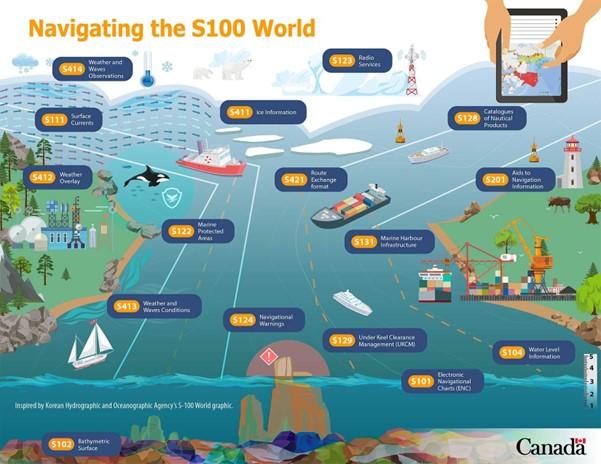
Image courtesy Fisheries and Oceans Canada (DFO)
This image depicts information about maritime navigation and data standards. It is divided into several sections, each illustrating different aspects of marine navigation and safety. It displays a range of S-100 based data models designated for specific maritime information.The different data models are:
S101 - Electronic Navigational Charts (ENC)
S102 - Bathymetric Surface
S104 - Water Level Information
S111 - Surface Currents
S122 - Marine Protected Areas
S123 - Radio Services
S124 - Navigational Warnings
S128 - Catalogues of Nautical Products
S129 - Under Keel Clearance Management (UKCM)
S131 - Marine Harbour Infrastructure
S201 - Aids to Navigation Information
S411 - Ice Information
S412 - Weather Overlay
S413 - Weather and Waves Conditions
S414 - Weather and Waves Observations
S421 - Route Exchange Format