
What’s changed
This marine notice supersedes 2025/01. It has been updated to:
- remove out of date information about the Russian oil price cap
- simplify punishment for offences information.
Guidance for
- Ship operators
- Masters
- Officers of the Watch (OOWs)
- Recognised organisations
- Flag states
Purpose
The purpose of this Marine Notice is to remind those who own, operate, or are on board Australian ships, about offences under Australian sanction laws.
Australia’s sanction laws
Sanction laws may, among other things, prohibit:
- the export or import of certain goods to or from certain countries, entities and individuals
- the provision of related services, including technical advice, assistance or training and financial services.
Offences arising under Australian sanction laws have extended geographical jurisdiction— category A status under the Criminal Code Act 1995 (Cth). This means the offences apply in a range of circumstances, including where conduct constituting an alleged offence occurs on board an Australian aircraft or an Australian ship, or by an Australian citizen outside of Australia.
For these purposes, ‘Australian ship’ is defined by the Criminal Code Act 1995 (Cth) to mean:
- a ship registered, or required to be registered, under the Shipping Registration Act 1981; or
- an unregistered ship that has Australian nationality; or
- a defence ship.
Australian sanction laws implement two types of sanctions frameworks - United Nations Security Council (UNSC) sanctions frameworks, which Australia implements in accordance with its obligations under international law, and Australian Autonomous sanctions frameworks, which Australia implements as a foreign policy tool.
Sanctions frameworks are amended regularly. Full and current details of UNSC and Australian autonomous sanctions are available on the Department of Foreign Affairs and Trade (DFAT) website.
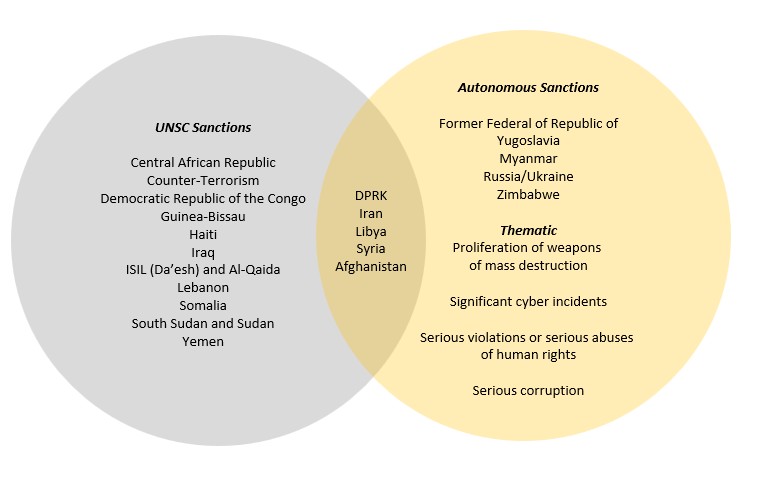
Figure 1: Sanctions frameworks implemented by Australia
Offences arising under Australian sanctions laws
Offences arising under Australian sanctions laws may apply to conduct that occurs on board an Australian ship, as well as conduct by Australians on foreign flagged vessels.
It can be a criminal offence under both the Charter of the United Nations Act 1945 and the Autonomous Sanctions Act 2011 for an individual or body corporate to:
- make a ‘sanctioned supply’ of ‘export sanctioned goods’ or a ‘sanctioned import’ of ‘import sanctioned goods’ without authorisation, or
- to provide the services of an Australian ship to assist with, or in relation to, a ‘sanctioned supply’ or a ‘sanctioned import’ without authorisation.
Offences under Australian sanctions laws are punishable by sizeable fines or imprisonment.
Additionally, where a vessel has been designated as a ‘sanctioned vessel’, the Foreign Minister may direct that vessel to leave or not to enter Australian waters. It is an offence not to comply with that direction.
Importing Russian goods
Since 25 April 2022, Australia has prohibited the importation, purchase or transport of Russian ‘import sanctioned goods’ if the goods are exported from Russia (or a part of Russia) or the goods originate in Russia (regulation 4A of the Regulations). This is referred to as making a sanctioned import.
It as an offence to use the services of an Australian ship to transport ‘import sanctioned goods’, regardless of whether the person is in Australia or is an Australian citizen.
‘Import sanctioned goods’ for Russia include:
- arms and related matériel
- crude oil (AHECC 2709)
- refined petroleum products (AHECC 2710).
Other ‘import sanctioned goods’ designated for Russia can be found in the Autonomous Sanctions (Import Sanctioned Goods - Russia) Designation 2022).
Oil Price Cap
Australia has also implemented price caps on Russian crude oil and on refined petroleum products (collectively the Oil Price Cap (OPC) measure).
The price caps prohibit the provision of services (transport, insurance, financing) in relation to the maritime trade of Russian crude oil and refined petroleum products where those goods have been purchased at a price above the relevant cap.
In September 2025 Australia lowered its price cap on Russian crude oil to USD47.60 per barrel.
The OPC measure aims to support stability in global energy markets while reducing the revenue Russia receives from crude oil and refined petroleum products. This forms part of a comprehensive suite of measures Australia has introduced to impose costs on Russia for its illegal and immoral invasion of Ukraine.
Please refer to website of the Australian Sanctions Office (ASO) within DFAT for information on the OPCs and related sanctions permits.
Further information
This document is explanatory only, does not have the force of law and does not in any way constitute legal advice. This document does not supplement or modify regulations made under the Charter of the United Nations Act 1945 or the Autonomous Sanctions Act 2011.
The Australian Government strongly recommends that those seeking to trade overseas consider obtaining legal advice in relation to Australian sanctions laws, as well as any other relevant Australian or foreign laws.
Australian Sanctions Office
The ASO within DFAT can provide general guidance but does not provide legal advice, nor can they provide specific advice regarding proposed or hypothetical activities.
Regulated individuals and entities are responsible for understanding their obligations and taking steps to determine whether a particular activity is compliant with Australian sanctions laws or requires a permit.
To contact the ASO, please email sanctions@DFAT.gov.au or submit an enquiry through the contact form via the Australian Sanctions PAX Portal.