
In this edition:
- Marine Order 503 consultation
- Recommendation responsibilities
- Specific exemption applications
- Australian builder’s plates (ABP) for DCVs
- DCV electrical wiring requirements - follow up
- Trolling motors as auxiliary outboards
- Buoyant appliance requirements for existing domestic commercial vessels
- AMS workshop recordings now available – August and December 2025
- Survey Matters for builders
Marine Order 503 consultation
Consultation is underway on proposed revisions to Marine Order 503 aimed at improving clarity, reducing unnecessary administrative burden, and making the requirements more practical for surveyors to apply in day-to-day certification and compliance activities.
The proposed changes include:
- clarifying requirements for novel vessels
- clarifying the standards for vessels that choose to be surveyed by a recognised organisation
- clarifying the triggers for transitional vessel standards and timing for renewal surveys
- implementing the NSCV Part C2 (Watertight and weathertight integrity) for new vessels, and removing the older standards in the USL Code
- clarifying and streamlining a number of other standards and survey requirements
- improving the readability and clarity of the marine order.
The consultation is open until Monday 20 April 2026.
Recommendation responsibilities
Recent reviews have identified instances where documents and drawings have been assessed (stamped) by one surveyor, while the recommendation has been submitted by a different accredited surveyor. This practice does not align with the requirements of the regulations or the Marine Surveyors Accreditation Guidance Manual (SAGM).
If you surveyed it, you recommend it.
- More on recommendation responsibilities
AMSA relies on the recommendation of a surveyor to be satisfied that a vessel complies with the applicable legislation, exemptions and standards.
A recommendation is not an administrative formality. It is the formal declaration that the survey activity has been completed in accordance with the National Law and that the surveyor is satisfied that the vessel meets the applicable standards and exemptions.
Chapter 2 of the SAGM outlines the control of the survey process. After completing a survey, the surveyor must make a recommendation to the National Regulator about the vessel’s compliance (section 2.9). The recommendation is therefore inseparable from the survey itself and is the final step in the survey process.
Reliance on third parties
Section 2.7 of SAGM provides important context. It states that third parties cannot conduct a survey, or part of a survey, on behalf of the surveyor.
While third parties may provide supporting documentation such as NDE reports, electrical certification, or equipment service certificates the responsibility for conducting the survey and forming the compliance view remains with the surveyor.
This principle extends directly to recommendations. The surveyor who undertakes the survey activity is the surveyor responsible for the recommendation.
The recommendation must be made by the surveyor who carried out the assessment
SAGM Section 2.9 states that Section 36 of the National Law Regulation requires recommendations to be in writing and in the form specified in SAGM.The AMSA 606 form is specified for this purpose, however, the note below Section 2.9 goes on to state that a recommendation made in MARS satisfies this requirement, provided supporting documentation is attached.
A recommendation cannot be made by a surveyor who did not conduct the relevant survey activity.
If different surveyors undertake different components of a survey (for example, plan approval), each surveyor must make the recommendation relevant to the survey tasks they conducted noting this may require additional codes to be created in MARS.
Administrative assistance
There is an important distinction between administrative assistance and professional responsibility.
Administrative staff may assist with uploading documents or entering information into MARS. That is entirely acceptable, particularly where survey practices are structured to use support staff.
However, the recommendation itself must reflect the surveyor who conducted the survey task. An AMSA 606 form serves this function. It must be completed and signed by the surveyor and uploaded into MARS by the support staff.
Why it’s important
This requirement is not merely procedural, it supports the integrity of the survey system.
The SAGM requires that the survey process be transparent, reviewable, and auditable (section 2.6). When recommendations are submitted by a surveyor other than the one who performed the work, transparency is reduced. It becomes harder to clearly identify who exercised professional judgment and who is accountable for the compliance decision.
A simple principle
If you surveyed it, you recommend it.
If there is uncertainty in a particular circumstance, surveyors or administrative staff are encouraged to seek clarification from Vessel Safety Unit before lodging the recommendation.
Maintaining clarity about who makes the recommendation is a part of upholding regulatory integrity and professional accountability within the survey system.
Specific exemption applications
An increased number of specific exemption (SPEX) applications are being received, many being submitted are of poor quality.
To avoid processing delays and refusals, ensure the submission addresses the relevant statutory and policy requirements.
- Meeting SPEX application requirements
Under section 143 of the National Law, AMSA may only grant an exemption if satisfied that the exemption will not jeopardise the safety of the vessel or anyone on board.
In addition to this statutory requirement, applications must meet the eligibility criteria set out in the AMSA Specific Exemptions Policy PDF370.72 KB. Applicants must demonstrate:
- extraordinary reasons why the vessel cannot comply with the applicable legislative or standard requirements
- that the proposed exemption and proposed controls (conditions) will maintain safety.
Applications that do not meet these criteria are likely to be refused.
If you are advising a vessel owner, or preparing an application on their behalf, the first step should always be to pursue full compliance with the applicable standards. A SPEX application should only be considered where the circumstances clearly meet the eligibility criteria.
Example of a poor application justification
A vessel owner is reluctant to complete required modifications to meet the applicable standards because they are costly and inconvenient to comply with.
This justification does not meet AMSA’s policy threshold for approval of an exemption, and even if it may be safe to grant the exemption, will result in refusal of the application.
Supporting information and requests for information
To facilitate the assessment process, applicants must provide clear and comprehensive rationale for the exemption request.
AMSA is not required to undertake additional research or enter discussions with an applicant during an assessment. Therefore, the initial application must be as complete as possible.
Include photographs, drawings, surveyor reports, and, where applicable, copies of any previous related approvals.
This information assists AMSA in understanding:
- why compliance with the applicable standards cannot be achieved
- the operational impact of the noncompliance
- any proposed risk controls or alternative measures intended to maintain vessel and personnel safety.
Decision process
Once the application and supporting materials have been assessed, a written decision will be issued. The exemption will either be granted (usually with conditions) or refused. In the case of a refusal, written reasons will be provided outlining the basis for the decision.
Decisions to approve or refuse an exemption are subject to internal review. If an applicant is dissatisfied with the outcome of their application, they may request this review within 30 days of receiving the decision.
Trends in exemption applications are continuously monitored, particularly where common themes emerge. This analysis contributes to the ongoing review and development of relevant national standards and regulatory frameworks.
Australian builder’s plates for domestic commercial vessels
The Australian Builder’s Plate (ABP) is a mandatory safety label fitted to recreational boats that are built in or imported into Australia. It was introduced to improve recreational boating safety and serves as a declaration by the builder or certifier that the vessel meets specified safety requirements.
The governing document is the National Standard for the Australian Builders Plate for Recreational Boats (Edition 5) published by the Australian Recreational Boating Safety Committee (ARBSC).
This standard has been adopted into the marine legislation of each Australian State and the Northern Territory and is enforced through recreational vessel registration requirements.
This standard has been adopted into legislation in each Australian state and Territory. It references several international standards, along with AS 1799.1, the Australian small craft design standard, to determine the information required on the ABP. The standard applies to recreational boats up to 24 m in length, with certain vessel types excluded.
The ABP is intended for recreational vessels and should be treated as supporting information only, not as evidence of full compliance with commercial vessel construction or operational standards.
While there no specific reference to the ABP within the NSCV, it can be used as supporting evidence in certain DCV applications, particularly:
- EX02 applications – a photograph of the ABP is required as part of the submission.
- EX40 inspections – the ABP may assist in confirming maximum power rating, number of persons, load capacity and associated stability criteria, and the type of buoyancy fitted (level flotation or basic flotation) with limitations.
Important limitations of the ABP
It is essential to understand that the ABP has limitations when used in a commercial context:
- the ABP does not verify hull construction standards
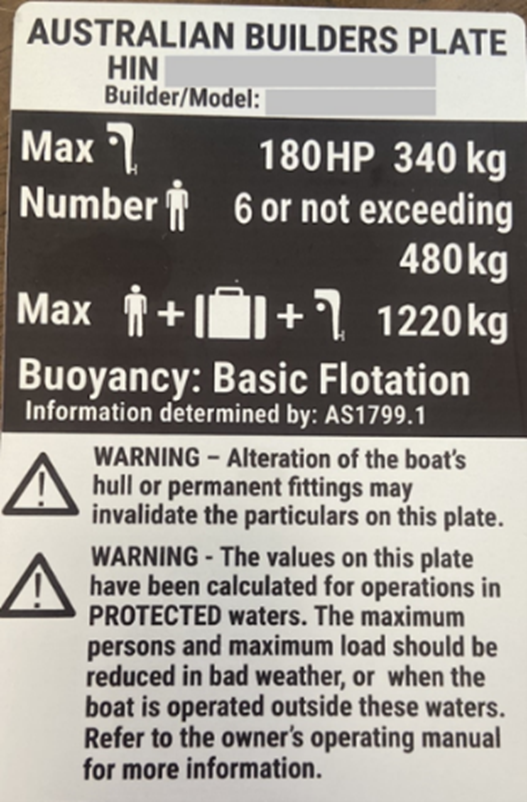
- most ABPs are issued for vessels intended to operate in sheltered or protected waters. Where a vessel is intended to operate in open waters (NSCV Operational Area C), AMSA will not accept an ABP as evidence the vessel is suitable for the intended operation if it has been assessed for protected waters only.
The following example of an ABP states that the details are for protected waters only.
DCV electrical wiring requirements - follow up
In December 2025, we sent an industry update to surveyors on electrical wiring to highlight the need to verify compliance with the NSCV C5B standard. Several questions were raised by the AMS cohort in response to this update.
The advice below addresses these questions to clarify how AS/NZS 3004.2, as adopted by NSCV C5B, relates to Domestic Commercial Vessels (DCVs) to which NSCV C5B applies.
The information below reflects the current standards framework. It does not amend or limit obligations under the Marine Safety (Domestic Commercial Vessel) National Law Act 2012 (National Law).
- DCV electrical wiring questions and answers
1. Accountability: nonelectrical surveyors and Form 563/564 signatories
Under the National Law (Division 2 – Duties of designers, builders, suppliers etc.), general safety duties apply to persons beyond Accredited Marine Surveyors.
What this means in practice
Electrical compliance of vessels under construction, refit or repair remains the responsibility of a competent electrical person. This will generally be:- a licensed electrician
- electrical surveyor
- a competent person (for Extra-Low Voltage (ELV) systems).
The person signing Form 563/564 and is accountable for confirming compliance with applicable standards.
2. Role of surveyors
Periodic survey
Periodic surveyors are not required to verify that cabling meets the standards that were applicable at the time of build. Surveyors must:
- Where visible, assess the condition and suitability for continued service of existing wiring and associated connections and support. If found unfit for purpose, ensure it is replaced with compliant cable by a licensed electrician or for ELV, a competent person. (See Survey Matters December 2024 for more information on periodic survey of electrical installations).
- Check for new installations or modifications to existing wiring. Verify that the work has been undertaken with compliant cable by a licensed electrician or for ELV, a competent person. This may also trigger the requirement for initial survey and require a certificate of electrical compliance for the new work.
Survey of new-builds or vessels undergoing refit or repair
Surveyors and builders must ensure that the electrical cabling used in a new-build, refit or repair meets the requirements of NSCV C5B and AS3004.2 referenced within.
Surveyors should:
- discuss the electrical installation with the builder, installer and / or cable supplier and ensure that the cabling has been approved against the standards listed in AS3004.2 for its intended purpose
- obtain evidence that the cabling meets the standards. AS5000.1 Ch16 requires that the outer surface of cables be marked directly at intervals not exceeding 550mm or be marked on inner components at intervals not exceeding 275mm
- cable packaging must also be labelled, tagged or directly marked with information outlined in AS5000.1 Ch16, including the standard to which it complies
- further evidence may be sought such as packing invoices that indicate the cabling standard, or a qualification test report from the supplier.
Future action
Following publication of the revised AS/NZS 3004.2, AMSA will review Forms 563 and 564 to improve end-user guidance.
3. Proprietary equipment supplied with unidentified cabling
Where wiring is supplied as part of a manufacturer’s installation kit, the manufacturer is responsible for ensuring conformity with an applicable standard.
Effect for surveyors
Separate verification of cable compliance is not required in this scenario, unless there is evidence of non-conformity.4. Cable construction and conductor requirements (moisture resistance, flame retardance, “tinned” copper)
Cable selection is governed by AS/NZS 3004.2 clause 6.1 (Selection of cables for the marine environment).
Clause 6.1 requires:
- cables must conform to AS 60092.350 or AS/NZS 5000.1
- conductors must be annealed copper and be Class 2 or Class 5 (IEC 60228 / AS/NZS 1125)
- solid conductors and aluminium conductors are not permitted.
Is “tinned copper” mandatory?
Neither AS/NZS 3004.2 nor NSCV C5B imposes a blanket requirement for “tinned copper” conductors. Compliance is determined by meeting the cited standards.
5. Guidance on acceptable cable products
AMSA does not certify products or maintain a list of compliant components.
Cable suitability must be determined on site by a competent person with reference to AS/NZS 3004.2 and related standards.
Note: Low Smoke Zero Halogen (LSZH) attributes may be present in compliant products but are not, of themselves, determinative.
6. Use of AS/NZS 5000.2 on ELV only vessels
AS/NZS 3004.2 clause 6.1 uses mandatory language (“shall”). It requires that cables comply with AS/NZS 5000.1 or AS 60092.350. There is no exception for Extra Low Voltage (ELV) only vessels.
7. Scope and allocation of ELV cable types
Where AS/NZS 3004.2 does not address a cable category (for example, many non-power data or control cables), compliance may be demonstrated against:
- applicable international standards (for example, the IEC 60092 series or ISO/IEC structured cabling standards)
- recognised marine industry practice.
OEM harnesses and fly‑leads
Manufacturer-supplied leads fitted to equipment (for example, navigation lights or engine harnesses) are acceptable if they comply with the relevant marine standards applicable to that equipment.8. Why is AS/NZS 5000.1 the chosen standard?
AS/NZS 5000.1 is chosen because it reflects the hostile marine environment and provides enhanced insulation performance compared with AS/NZS 5000.2.
9. Overseas builds, IEC 60092 cables and 150/250 V instrumentation cables
AS/NZS 3004.2 permits compliance by reference to IEC 60092 series. Cables that comply with IEC 60092 are acceptable. Instrumentation cables rated 150/250 V and approved to IEC 60092 are acceptable.
10. Cables with class approvals but no IEC 60092 reference
It is unlikely that class cabling does not comply with the IEC 60092 series, however, this should be verified with the builder / supplier.
11. Revision of AS 3004.2 standard
Scope and segregation issues have been raised with Standards Australia as part of the current revision process for AS/NZS 3004.2.
The revised AS/NZS 3004.2 has completed the public comment stage. The Standards Australia committee is currently reviewing submissions received during the consultation period.
Trolling motors as auxiliary outboards
Recent reviews have identified cases where vessel owners have attempted to use a bow-mounted electric trolling motor in place of a required auxiliary outboard engine. While these devices can be useful for low-speed manoeuvring or fishing, they do not meet the requirements of NSCV Part C5A for redundancy in propulsion on seagoing vessels.
Clause 2.14.4 of NSCV C5A sets out the requirements for vessels powered by outboard engines. Seagoing vessels must have at least two outboard engines, each permanently attached to the transom, with enough independent propulsion and steering capability to allow the vessel to reach a safe haven in the weather conditions likely to be encountered in its operational area.
This redundancy ensures that if the main engine fails, the vessel can still maintain control and return to safety without relying on external assistance.
Vessels requiring two outboard engines
The following vessels are required to be fitted with two outboard engines: seagoing vessels powered by outboards, except where specifically allowed to use a single outboard under NSCV C5A, Clause 2.14.4.3.
Vessels permitted to use a single outboard engine
Only limited categories of vessels may operate legally with a single outboard engine as per NSCV C5A, Clause 2.14.4.3:2.
- Class C vessels using fuel with flashpoint ≥ 60°C. These vessels may use a single outboard engine where the engine operates on fuel with a flashpoint of 60°C or more.
- Certain Class 2 and Class 3 vessels under strict restrictions: a single outboard engine is permitted only where all conditions in Clause 2.14.4.3 are met, including:
- operating within 5 nautical miles to sea and 30 nautical miles laterally from sheltered waters or a safe haven
- having an alternative means of emergency propulsion and rescue services are readily available
- the vessel does not carry passengers.
Why a bow‑mounted electric motor does not comply
A bow mounted trolling motor does not meet the definition or intent of an auxiliary outboard engine under the standard. It is:
- not mounted on the transom
- not an outboard engine
- not designed for sustained propulsion at the level required for emergency return capability - particularly in adverse wind, seas and currents.
Industry experience has highlighted several performance limitations with bow-mounted electric trolling motors, including:
- duty cycle limitations – many trolling motors cannot operate at extended output (e.g. 75% power for several hours) without overheating or shutting down
- battery dependency – after normal use (e.g. fishing), the battery powering the auxiliary motor may not be at full capacity.
Because of these limitations, a bow-mounted electric motor cannot meet the reliability, redundancy, and performance requirements of Clause 2.14.4.
Ensuring vessels meet the standard
Operators, owners, and surveyors are encouraged to review vessels against NSCV C5A Clause 2.14.4 before applying for a Certificate of Survey or making modifications to a vessel currently in survey. Proper auxiliary propulsion is essential not only for meeting regulatory requirements but also for ensuring vessels can operate safely and reliably across Australia’s diverse marine environment.
Buoyant appliances on existing domestic commercial vessels
There have been multiple enquiries from operators and surveyors regarding the use of lifejackets as buoyant appliances to meet safety equipment requirements.
Under the current framework, NSCV C7A requires buoyant appliances comprise a specified portion of a Class 1E vessel’s complement, with lifejackets considered separately. Compliance with this standard is mandatory for all vessels under Marine Order 503 (Certificates of Survey – National Law).
Previously, under the Uniform Shipping Laws (USL) Code, lifejackets could be used alongside buoyant appliances, dinghies, and lifebuoys for these vessels, provided the total capacity equated to 115% of the vessel’s complement.
The number of buoyant appliances within that total was largely determined by state marine authorities, with many requiring a minimum of 40% buoyant appliance capacity.
When the National System was introduced, this 40% minimum was formally incorporated into NSCV C7A, and Marine Order 503 was updated in late 2017 to bring existing vessels into compliance.
Annex I of NSCV C7A introduced compliance timeframes for existing vessels to meet the updated safety equipment requirements.
Surveyors should note that the compliance timeframe for buoyant appliance requirements under NSCV C7A expired on 1 January 2022. Refer to Survey Matters March 2022 for more information.
Lifejackets are not buoyant appliances
Although lifejackets are critical items of safety equipment, they do not meet the design and construction requirements for buoyant appliances set out in NSCV C7A – Safety Equipment, Annex F - Requirements for Buoyant Appliances.
Key requirements
NSCV C7A requires vessels to carry sufficient buoyant appliances, lifebuoys, dinghies or combination for 40% complement subject to the following caveats:
- open reversible liferafts of equivalent aggregate capacity may replace dinghies and buoyant appliances for vessels operating in sheltered or smooth waters.
- an open reversible liferaft may be required if the vessel operates in waters with a mean monthly temperature of less than 15 degrees unless it can be otherwise shown that the risk of immersion is mitigated by other factors such as proximity to the shore.
If the risk of immersion can be shown to be mitigated (and documented in the SMS), the vessel may apply the warm water requirement.
In practice, many smaller 1E vessels with relatively small passenger numbers meet the 40% requirement by installing:
- a buoyant appliance such as a carley float
- lifebuoys mounted on a transom rack or on the cabin-top in a float free position where ready access is available. Note that lifebuoys used for this purpose are in addition to the vessel lifebuoys required under NSCV C7A Table 2.
Noting that the equipment must comply with the installation, construction and performance requirements outlined in NSCV C7A Chapter 4 and Annex F.
Responsibilities for vessel owners and surveyors
Owners and surveyors should ensure that:
- vessels carry buoyant appliances, lifebuoys, dinghies or combination to support at least 40% of the vessel’s complement
- lifejackets should not be counted toward the 40% buoyant appliance requirement.
Compliance forms part of the owner’s general safety duty under the Marine Safety (Domestic Commercial Vessel) National Law Act 2012.
Workshop recordings now available
August 2025 - accreditation and DCV inspections
- updates on the accreditation framework and industry reference group
- overview of DCV inspections, common findings, and trends
- practical tips to improve compliance outcomes.
December 2025 – recommendations and applications
- improving quality and consistency of MARS recommendations
- common application issues and internal process insights
- steps to reduce delays and rework, including Temporary Operation Permits.
All surveyors are encouraged to watch the recordings.
Workshop recordings can only be accessed by Accredited Marine Surveyors.
If you are an Accredited Marine Surveyor and cannot access them, please contact DCVSurvey@amsa.gov.au.
Next workshop: April 2026 – details to be emailed closer to the date.
Survey Matters for builders
Survey Matters is distributed to surveyors and vessel builders on our mailing list and is also published on our website for wider access. While primarily aimed at surveyors, many of the articles address issues that are equally relevant to vessel builders and owners and broader awareness can help ensure these groups are working from the same understanding of regulatory expectations and best practice.
Surveyors can assist by raising awareness of Survey Matters with the builders they work with and encouraging them to subscribe by contacting DCVsurvey@amsa.gov.au.
We want your suggestions
Survey Matters aims to be relevant and useful for accredited marine surveyors, boat builders, class societies, and others involved in the survey of domestic commercial vessels.
You're invited to submit topics or ideas for future articles that would be helpful to the industry. Please send suggestions to DCVSurvey@amsa.gov.au.