
Showing 341 - 360 of 770 results for WA 0852 2611 9277 Jasa Borong Interior Ruang Jemur Lantai 2 Daerah Pamulang Kota Tangerang Selatan
- New requirements for lifting appliances and anchor handling winchesWhat changes did we seek feedback on?Last updated: 02/09/2026
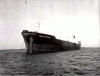 Princess Anne Marie, 14 July 1975On 14 July 1975 the Marine Operations Centre in Canberra was alerted that the oil tanker Princess Anne Marie had sustained a large crack in its hull approximately 300 miles off Western Australian.Last updated: 11/09/2020
- Exemption 16 - Marine Safety (Traditional fishing)This exemption allows people to master a traditional inhabitant fishing boat without the required certificate of competency.Last updated: 12/23/2025
- Protection of the sea conventions and legislationAustralia is a part of the International Maritime Organization — maritime safety and marine pollution prevention are more effective when carried out internationally.Last updated: 12/03/2024
- Is it a domestic commercial vessel?In Australia, domestic commercial vessels are regulated under the Marine Safety (Domestic Commercial Vessel) National Law Act 2012 (national law act). The National Law Act underpins the National System for Domestic Commercial Vessel Safety (national system).Last updated: 09/10/2025
- Exemption 23 - Marine Safety (Masters or crew without certificates)This exemption allows people who were working on a domestic commercial vessel (DCV) under state or Northern Territory law on 30 June 2013, to continue working without the required certificate.Last updated: 12/23/2025
- Scale G first aid kitsSurvey vessels in these classes are required to carry a Scale G first aid kit on board: 1D (with unberthed passengers), 1E (with unberthed passengers), 2D, 2E, 3D and 3E.Last updated: 12/23/2025
 Editorial updates to 8 parts of the NSCV effective 1 October 2024From 1 October 2024, minor editorial changes were implemented for 8 parts of the National Standard for Commercial Vessels (NSCV).Last updated:
- 2025/05 - Revalidation of Australian STCW certificatesGuidance on revalidating Australian certificates of competency and proficiency issued in compliance with the International Convention on Standards of Training, Certification and Watchkeeping for Seafarers (STCW).Last updated: 11/21/2025
- Crewing guidance for domestic commercial vesselsGuidance on crewing of domestic commercial vessels as per Schedule 1 Clause 6 - Appropriate crewing and Clause 8 - Minimum crewing of Marine Order 504 (Certificates of operation - national law) 2024. Schedule 1 applies to all vessels other than class 4 vessels.Last updated: 10/16/2025
- Flag coloursRequirements for national colours of flags for Australian ships.Last updated: 07/08/2020
- 2021/08 — Electronic Chart Display and Information SystemsThis marine notice draws attention to important information regarding the proper operation of Electronic Chart Display and Information Systems (ECDIS), including the importance of adequate and up to date Electronic Navigational Charts (ENCs), for ships visiting Australian ports.Last updated: 01/10/2025
- 2024/09 - Voyage Planning and Execution within Planned Navigation CorridorsPurpose To ensure that navigation corridors are used appropriately when planning on ECDIS, and to ensure that a voyage plan approved by the ship’s Master is executed within the planneLast updated: 01/10/2025
- Survey modifiersSurvey modifiers are high risk operations and vessel attributes that change the survey and other requirements that would otherwise apply to the vessel.Last updated: 12/11/2020
- Survey Matters - June 2022In this edition we talk about audits and application assessments.Last updated: 06/28/2022
- 2018/02 — Electronic Visual Distress Signals (EVDS)This marine notice advises vessel owners, vessel operators, masters, officers, seafarer training organisations and industry organisations that AMSA does not consider electronic visual distress signals (EVDs) to be a suitable replacement for pyrotechnic distress signals.Last updated: 01/10/2025
- Survey Matters—December 2020In this edition we give guidance on managing some of the changes mentioned in Schedule 1 of MO503, explain electrical plan approval requirements, and more.Last updated: 04/04/2025
- Uniform waypoints—Great North East ChannelContains three charts of uniform waypoints—Great Barrier Reef—Great North East Channel, eastbound and westbound.Last updated: 03/14/2025
- Parasailing incident leaves passengers injured; operator fails to reportAn unexpected wind-shift during parasailing operations caused 2 airborne passengers to contact the water at speed. They were recovered by the vessel and returned to shore. Both passengers later informed the operator that they had sustained injuries during the event. The owner then failed to report this as a marine incident to us.Last updated: 08/08/2024