AMSA Connect phone services may have longer wait times on Monday 1 June 2026 while we operate with reduced staffing due to the Reconciliation Day Public Holiday in Canberra. Our search and rescue team will continue to operate during this time.
Showing 181 - 200 of 1325 results for WA 0812 2782 5310 Daftar Harga Pembuatan Plafon Gypsum Dan Kalsiboard Murah Serengan Surakarta
- Western Australia fuel oil suppliersFind local suppliers of fuel oil in Western Australia.Last updated: 11/19/2025
- Search and rescue incidents 2015–16Our search and rescue incidents from 2015–16.Last updated: 10/26/2020
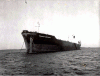 Princess Anne Marie, 14 July 1975On 14 July 1975 the Marine Operations Centre in Canberra was alerted that the oil tanker Princess Anne Marie had sustained a large crack in its hull approximately 300 miles off Western Australian.Last updated: 11/09/2020
- 2025 quarterly domestic commercial vessel incident reportsThe information you provide in your incident report plays an important part in guiding the way we improve maritime safety for everybody on the water. By reporting marine incidents to us, you are also meeting your reporting obligations under Australian laws.Last updated: 03/16/2026
- Exemption 40 - (Operational area) DeterminationThis determination identifies the parts of operational area C in which a vessel approved under Exemption 40 may operate.Last updated: 07/01/2025
- Satellite-Based Augmentation System (SBAS)A Satellite-Based Augmentation System (SBAS) is now available in the Australia and New Zealand region.Last updated: 09/18/2023
- Exemption 24 - Marine Safety (Emergency service vessels)Exemption 24 allows volunteer emergency services to crew their vessels using trained volunteers without a certificate of competency.Last updated: 10/03/2025
- Exemption 13 - Marine Safety (Wildlife or other sightseeing)This exemption is for people who want to work on a domestic commercial vessel being used for a wildlife or other sightseeing operation in inland waters.Last updated: 06/30/2025
- Transporting livestock from AustraliaOperators of Regulated Australian Vessels (RAV) and Foreign Vessels, as well as the shippers of livestock, have obligations when loading and transporting livestock from Australia.Last updated: 01/04/2024
- First aid certificatesLearn your options for fulfilling the mandatory requirement to hold a first aid certificate or equivalent when applying for a domestic certificate of competency.Last updated: 03/12/2025
 Electrical safety - reducing the risk of electrical faults and firesMake electrical safety a priority. Reduce the risk of electrical fire from batteries and electrical installations on your vessel.Last updated: 07/31/2024
 National Maritime WHS Regulators ForumThe National Maritime Work Health and Safety (WHS) Regulators Forum is a collaborative platform for discussing maritime workplace health and safety. Its main aim is to improve safety for domestic commercial vessels.Last updated: 03/25/2024
- Montara Well Head Platform, 21 August 2009At approximately 5.30 am WA time on Friday 21 August 2009 the Montara Wellhead mobile drilling unit, located 140 miles offshore from the north-west Australian coast, had an uncontrolled release of hydrocarbons from one of the platform wells. Consequently oil escaped to the surface and gaseous hydrocarbons escaped into the atmosphere.Last updated: 11/09/2020
- 2023 monthly domestic commercial vessel incident reportsThe information you provide in your incident report plays an important part in guiding the way we improve maritime safety for everybody on the water. By reporting marine incidents to us, you are also meeting your reporting obligations under Australian laws.Last updated: 02/23/2024
- Marine levy payment portalPayment options for marine levies, fees, or charges.Last updated: 10/01/2025
- Global maritime distress and safety systemThe global maritime distress and safety system (GMDSS) connects you to coast stations and vessels via satellite and radio communications when you're out at sea.Last updated: 10/09/2023
- Guidelines for a safety management systemA guide for domestic commercial vessels to develop their safety management system for class 1, 2, 3 and 4 operations.Last updated: 12/04/2025
- Residual current devicesResidual current devices minimise the risk of a person receiving an electric shock or being electrocuted when using plug-in electrical equipment on board vessels.Last updated: 10/16/2023
- Exemption 23 - Marine Safety (Masters or crew without certificates)This exemption allows people who were working on a domestic commercial vessel (DCV) under state or Northern Territory law on 30 June 2013, to continue working without the required certificate.Last updated: 12/23/2025