AMSA Connect phone services may have longer wait times on Monday 1 June 2026 while we operate with reduced staffing due to the Reconciliation Day Public Holiday in Canberra. Our search and rescue team will continue to operate during this time.
Showing 181 - 200 of 573 results for WA 0859 3970 0884 Biaya Yang Dibutuhkan Untuk Membangun Plafon Simple Elegan Pasar Kliwon Surakarta
 National Maritime WHS Regulators ForumThe National Maritime Work Health and Safety (WHS) Regulators Forum is a collaborative platform for discussing maritime workplace health and safety. Its main aim is to improve safety for domestic commercial vessels.Last updated: 03/25/2024
- Era, 30 August 1992On 30 August 1992 the fuel tank of Era was ruptured by the bow of the tug Turmoil during berthing operations at Port Bonython, South Australia, during high winds. Approximately 300 tonnes of bunker fuel was released into Spencer Gulf.Last updated: 11/09/2020
- Al Qurain, 28 July 1988On 28 July 1988, the livestock carrier Al Qurain struck a wharf heavily while berthing in Portland, Victoria and severely ruptured a side fuel tank. An estimated 184 tonnes of fuel oil escaped into Portland Harbour.Last updated: 11/09/2020
- 2024 monthly domestic commercial vessel incident reportsThe information you provide in your incident report plays an important part in guiding the way we improve maritime safety for everybody on the water. By reporting marine incidents to us, you are also meeting your reporting obligations under Australian laws.Last updated: 01/28/2025
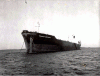 Princess Anne Marie, 14 July 1975On 14 July 1975 the Marine Operations Centre in Canberra was alerted that the oil tanker Princess Anne Marie had sustained a large crack in its hull approximately 300 miles off Western Australian.Last updated: 11/09/2020
 How to applyPrepare and submit your application for a role with us.Last updated: 11/13/2023
- 2023 monthly domestic commercial vessel incident reportsThe information you provide in your incident report plays an important part in guiding the way we improve maritime safety for everybody on the water. By reporting marine incidents to us, you are also meeting your reporting obligations under Australian laws.Last updated: 02/23/2024
- Iron Baron, 10 July 1995On Monday 10 July 1995, the Iron Baron chartered bulk carrier grounded on Hebe Reef at the approach to the Tamar River, northern Tasmania at 7.30 pm EST.Last updated: 11/09/2020
- Our international engagementAustralia has an interest in ensuring that the ships which visit our ports and transit our waters are seaworthy, have competent crews, and are able to safely navigate through our sensitive marine areas.Last updated: 01/08/2025
- Sanko Harvest, 14 February 1991The Sanko Harvest struck a reef off Esperance, Western Australia on 14 February 1991, and broke up over the next fortnight.Last updated: 11/09/2020
- Assessing the determinants and consequences of safety culture in the maritime industryThe purpose of this study was to provide new insights into seafarers’ safety and wellbeing by examining the influence of key organisational factors related to safety culture.Last updated: 01/03/2024
- Research into vegetable oil based biodiesels as a cleaning agent for heavy oil spillsResearch into vegetable oil based biodiesels as a cleaning agent for heavy oil spills.Last updated: 10/29/2020
- Proposed changes to helicopter operations on vessels: Marine Order 57 consultationWe sought feedback on proposed changes to Marine Order 57 (Helicopter operations). The proposed updates will ensure the marine order remains current and gives effect to new international requirements.Last updated: 05/05/2026
- Application of Maritime Labour Convention 2006We implement the regulations under the Maritime Labour Convention 2006 in Australia via supporting legislation which applies to all commercial vessels.Last updated: 01/11/2024
 Compliance strategy 2018–2022Our compliance strategy will help us focus our efforts on promoting voluntary regulatory compliance. It will ensure that we consider six important elements as we work with industry to promote maritime safety and to protect the marine environment.Last updated: 03/29/2021
- Maximum period of shipboard service for seafarersAdvice about the maximum continuous period that a seafarer can serve on board a vessel without taking leave.Last updated: 01/11/2024
- Search and rescue arrangements in AustraliaThe Australian states and territories work with us to coordinate an effective search and rescue (SAR) service.Last updated: 07/30/2020
- Survey Matters - June 2022In this edition we talk about audits and application assessments.Last updated: 06/28/2022
 myAMSA NOW OPEN – Apply online for your near coastal ticketmyAMSA is here! Save time and apply online for your next near coastal certificate of competency using our new application portal myAMSA.Last updated:
- 2023/06 - Means of embarkation and disembarkation from ships in portThis marine notice aims to raise awareness of the risks involved with getting on and off vessels.Last updated: 08/11/2023