On this page:
- About traditional inhabitant boats (TIB)
- Is my boat eligible for the TIB specific exemption?
- How do I operate under the exemption?
- What crew certificates do I need (exemption 16)?
- Got a question?
About traditional inhabitant boats (TIB)
If you use your TIB to catch seafood and sell it, your boat is being used as a domestic commercial vessel (DCV).
All DCVs must be approved by AMSA, but in the Torres Strait you may qualify for special exemptions.
You can still use your boat for traditional hunting, fishing and daily life, just not at the same time as when you use it for commercial fishing.
Is my boat eligible for the TIB specific exemption?
To qualify, you need to answer YES to all these questions:
- Do you hold an active Traditional Inhabitant Boat Licence for fishing and the boat is displayed with this boat mark?
- Is your boat less than 7.5m in length?
- Is fishing the only commercial activity you use your boat for?
- Do you only fish in the pink area where Torres Strait fisheries occur?
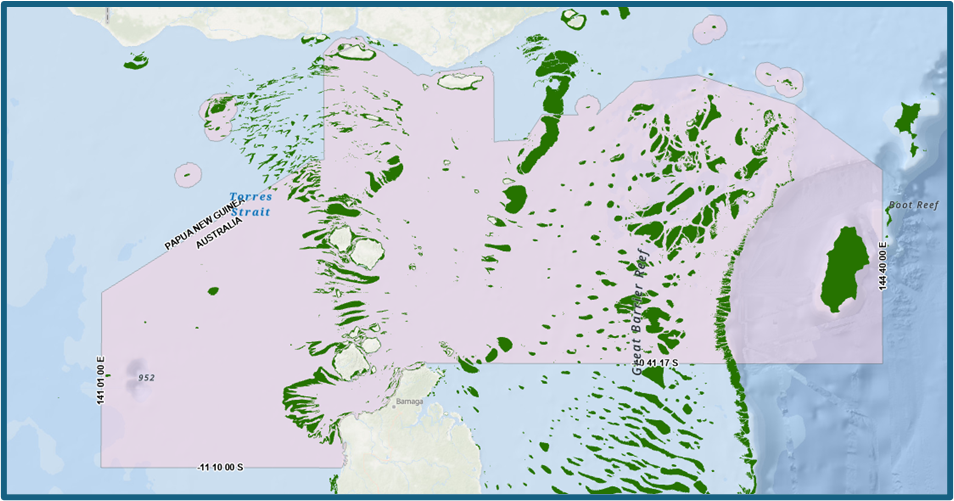
Torres Strait Fisheries
Check with AFMA on the particular limitations of your fishery license.
How do I operate under the exemption?
If you answered yes to all the questions above, you must:
- (1) Get your boat surveyed
Your vessel will need to be checked by an AMSA accredited marine surveyor. The surveyor will submit a report to AMSA.
If the boat passes the inspection, the surveyor will provide you with a statement of compliance.
Keep this on board. It proves your boat is exempt.
- (2) Apply for a unique vessel identifier (UVI)
This is your AMSA boat number.
You must show it clearly on the boat. It can be displayed with your TIB fish licence boat number.
- (3) Make sure you have the right equipment
You will need this safety equipment onboard.
Checklist
You can download the safety equipment checklist (on page 4) in the TIB Fishing guide PDF5.04 MB.
Safety equipment
- Level 150 coastal lifejacket for each person onboard
- Lifejackets must be labelled with the vessel’s identification number
- Anchor with chain and rope
- Sea anchor/drogue
- Bilge pump with capacity 4.0 kl/hr (see note below this list)
- Bailing bucket with lanyard
- Way to retrieve a person in the water, either:
- a rescue quoit
- a throw bag
- a lifebuoy with 30m of buoyant rope attached (may be included in the buoyant appliance for floatation)
- Flares in a waterproof container:
- 3 x parachute distress rocket flares
- 2 x red hand-held flares
- 1 x orange handheld smoke flare
- V Sheet
- First aid kit suitable for the type of operation, based on a risk assessment
- Waterproof torch or headlamp for each person on board
- 2 litres of water for each person onboard
Communication equipment
- Fixed VHF radio or a VHF handheld marine radio that:
- is waterproof
- floats
- has minimum 5W transmission power
- 406 MHz EPIRB with GPS, registered with AMSA
Navigation equipment
- A sound signal (horn) and a spare canister if compressed air canisters are used
- Signalling mirror
- Electronic navigation device (GPS) or marine chart of the operational area
- Compass (may be handheld)
- Navigation lights (if operating between the gazetted hours of sunset and sunrise and in limited visibility)
- A clock, watch or time telling apparatus
Fire equipment
- Minimum 20:B fire extinguisher suitable to the risk of fire on the vessel.
NOTE: New vessel greater than 5 metres and not self-draining – bilge pump of capacity 4.0 kl/hr.
Existing vessel – bilge pump of capacity 4.0 kl/hr.
NOTE: Equipment such as inflatable lifejackets or fire extinguishers will require servicing.
- Level 150 coastal lifejacket for each person onboard
- (4) Create a safety management system
This is a document that explains how you keep your crew and boat safe.
Find out how to make a safety management system.
- (5) Check you have the right crew certificate
You need to have the correct certificate of competency to operate the boat while fishing commercially.
Traditional Inhabitants may be able to use exemption 16 for commercial fishing.
Find out more about exemption 16 below.
- (6) Prepare for inspections
An AMSA inspector will contact you to check the boat from time to time in the future.
What crew certificates do I need (exemption 16)?
If you’re the Master (the person in charge of the boat), you must hold a valid AMSA certificate of competency (like a Coxswain) or meet the requirements for an exemption.
Exemption 16 lets Traditional Inhabitants operate a TIB for fishing without needing a full Certificate of Competency.
You don’t need to apply for this exemption, but you must meet the requirements and be able to show your certificates if asked.
Certificates for Masters of TIBs
| Pathways | What you need | When it applies |
|---|---|---|
| 1. Coxswain Grade 2 (Exemption 16) |
| You are a Traditional Inhabitant of the area where you will fish. |
2. Recreational licence + Certificate I (Exemption 16) |
and
| You are a Traditional Inhabitant of the area where you will fish. |
| 3. Coxswain Grade 1 (Certificates of Competency – national law) |
| When you do not wish to meet the requirements for exemption 16 and your TIB is:
|
*AMSA may accept other training programs as equivalent. Contact us if you're unsure.
Got a question?
Ask us anything about using your boat to sell seafood in the Torres Strait.
Here to help (Mela iya bla elp)
When you ask a question, we will put you in touch with an AMSA staff member who is dedicated to supporting Aboriginal and Torres Strait Islander crew and vessel operators. Our staff are based in regional areas like Cairns and Thursday Island.
Artwork: Baydham by Badu Island (Torres Strait) artist Michael Nona.
Want to speak to someone instead?
Contact the AMSA Connect contact centre on 1800 627 484 Monday to Friday 8am to 5pm AEDT (excluding national public holidays).