
Learn how to identify risks to vessel stability in your SMS.
New requirement: Identify the risks to vessel stability in the risk assessment.
Applies to: All vessels, except those eligible for a simplified SMS.
Came into effect: 1 June 2025.
See also: Record modifications affecting stability.
Stability refers to the ability of a vessel to return to its upright position after being heeled over by wind, waves, or other forces. A vessel that does not have sufficient stability is at risk of capsizing.
We introduced the requirement for operators to identify risks to vessel stability in their risk assessment. This is because failure to adequately assess stability risks may lead to a vessel capsizing.
How to identify and manage stability risks
- Step 1: Educate
Educate your master and relevant crew about stability limitations of your vessel and its operations.
- Step 2: Assess risks
Key risks to vessel stability that you may identify include:
- modifying a vessel or installing new equipment or fishing gear
- overloading or weight creep
- towing
- loss of watertight integrity or water on deck
- accidental flooding
- rough sea state and weather conditions.
Learn about stability risks for fishing vessels, construction barges and towing operations.
The best way to verify if a risk to stability has been appropriately considered is to assess the vessel against the applicable stability criteria in the National Standard for Commercial Vessels (NSCV), or if applicable, the Uniform Shipping Laws Code (USL Code).
Competent persons, such as accredited marine surveyors and naval architects, are best placed to assess vessel stability.
In some instances, operations may have to be modified for the vessel to remain stable and compliant with the stability book.
If you don’t know, ask a competent person such as accredited marine surveyor or naval architect.
Note: The presence of stability documents on their own does not ensure that the vessel will be stable in all operational scenarios. If in doubt, contact an accredited marine surveyor or naval architect.
Note: The requirement to identify stability risks in the risk assessment does not apply to vessels eligible for a simplified SMS, however, owners of these vessels should identify and manage any stability risks, such as vessel loading, through the risk assessment process.
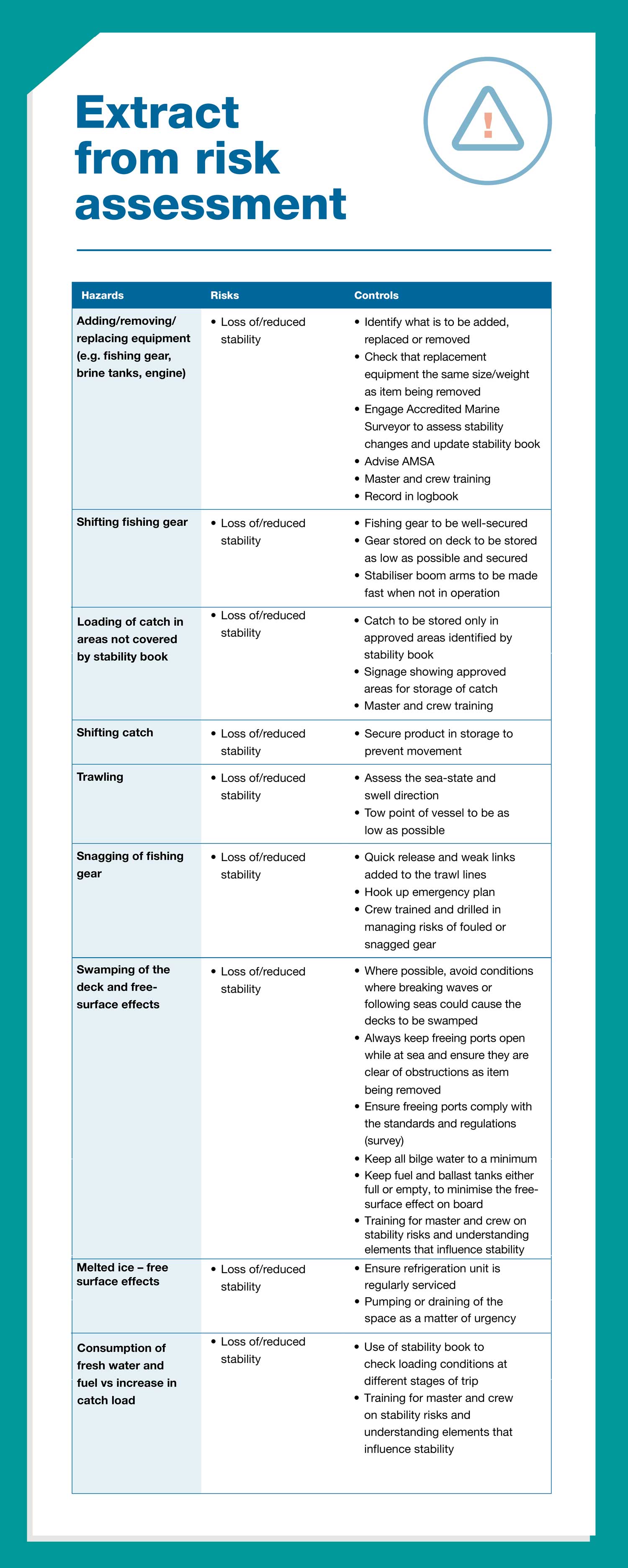
16m Class 3B fishing trawler
A 16m Class 3B fishing vessel undertakes fishing operations within 100 nautical miles of its home port. The vessel typically spends 21 days at sea.
The owners/operators get together with the master and crew and identify stability risks using the Guide to fishing vessel stability. After assessing the risks, the owner updates the risk assessment and procedures to include the identified risks and controls.
- Image description: Extract from risk assessment
Hazards Risk Controls Adding/removing/relocating/replacing equipment (e.g. fishing gear, brine tanks, engine) Loss of/reduced stability - Identify what is to be added, replaced, relocated or removed
- Check that replacement equipment is the same size/weight as item being removed
- Engage Accredited Marine Surveyor to assess stability changes and update stability book
- Advise AMSA
- Master and crew training
- Record in logbook
Shifting fishing gear Loss of/reduced stability - Fishing gear to be well secured
- Gear stored on deck to be stored as low as possible and secured
- Stabiliser boom arms to be made fast when not in operation
Loading of catch in areas not covered by stability book Loss of/reduced stability - Catch to be stored only in approved areas identified by stability book
- Signage showing approved areas for storage of catch
- Master and crew training
Shifting catch Loss of/reduced stability - Secure product in storage to prevent movement
Trawling Loss of/reduced stability - Assess the sea-state and swell direction
- Tow point of vessel to be as low as possible
Snagging of fishing gear Loss of/reduced stability - Quick release and weak links added to the trawl lines
- Hook up emergency plan
- Crew trained and drilled in managing risks of fouled or snagged gear
Swamping of the deck and free-surface effects Loss of/reduced stability - Where possible avoid conditions where breaking waves or following seas could cause the decks to be swamped
- Always keep freeing ports open while at sea and ensure they are clear of obstructions
- Ensure freeing ports comply with the standards and regulations (survey)
- Keep all bilge water to a minimum
- Keep fuel and ballast tanks either full or empty, to minimise the free-surface effect on board
- Training for master and crew on stability risks and understanding elements that influence stability
Melted ice – free surface effects - Ensure refrigeration unit is regularly serviced
- Pumping or draining of the space as a matter of urgency
Consumption of fresh water and fuel vs increase in catch load Loss of/reduced stability - Use of stability book to check loading conditions at different stages of trip
- Training for master and crew on stability risks and understanding elements that influence stability
Download or print and share this guidance: How to meet vessel stability requirements PDF322.54 KB
Webinar
Watch a recording of the safety management system requirements webinar, presented on 19 March 2025. We discussed the new vessel stability requirements, and answered questions from industry.
More on stability
Contact
Got a question about these requirements? Please contact us.