
Learn how to record modifications to the structure or equipment of a vessel that may change its stability.
New requirement: Record modifications to the structure or equipment of a vessel that may change its stability.
Applies to: Class 1, 2 and 3 vessels, including those eligible for a simplified SMS. Does not apply to Class 4 vessels.
Effective from: 1 June 2025.
See also: Stability risk assessment.
Modifications to the structure or equipment of a vessel may change its stability and the way it behaves at sea. Previous coronial findings have found that vessel modifications were factors in vessel sinking or capsize.
We introduced this change so that owners, masters and crew are aware of any modifications made to the vessel that may impact stability. This will help them decide how they use the vessel, and what conditions are safe to operate in.
Webinar 19 February
Join our upcoming webinar on managing operational stability risks in commercial fishing. Learn more and register.
Existing obligations: modifications
This requirement does not affect existing obligations to advise AMSA of vessel modifications, such as the obligations under:
- Marine Order 503 (Certificates of survey – national law) 2018
- Marine Safety (Class C restricted operations) Exemption
- Marine Safety (Certificates of survey) Exemption.
Under these requirements, vessel owners are legally required to inform AMSA of modifications made to their vessel. Depending on the extent of the modifications, the vessel may need to have its stability reassessed by an accredited marine surveyor and undergo other survey requirements.
How to record vessel modifications
You should record:
- hull or superstructure modifications
- addition, removal or relocation of fixed and moveable ballast
- addition or modifications to trawling, towing or lift apparatus apart from like-for-like replacement of apparatus that is addressed in the stability assessment of the vessel
- addition of external plastic curtains (clears)
- addition, removal or modification of the size or location of tanks such as fuel, fresh water, wastewater, lube oil, ballast water, sludge, live bait, fish tanks/fish bins or cargo tanks
- addition, removal, relocation or replacement of machinery including propulsion engines that are not a like-for-like replacement
- addition, removal, relocation or replacement of accommodation fit-out or equipment that would alter the displacement, trim or raise the centre of gravity of the vessel from the lightship condition for which it was previously approved e.g. cabins, refrigerators, air conditioners, compressors, cool rooms, ice rooms
- variation to the operational loading of the vessel including cargo and personnel weights and their location.
Note: This list of modifications is just a starting point. Different modifications may apply to your vessel.
You may record modifications in your logbook or in another document that can easily be accessed by the master and crew.
The record must include:
- a description of the modification
- the date of the modification.
24m Class 1D charter vessel
A 24m Class 1D charter vessel undertakes sightseeing and dinner cruises within the sheltered waters limits of its local operating area. Cruises typically last between 2 to 4 hours.
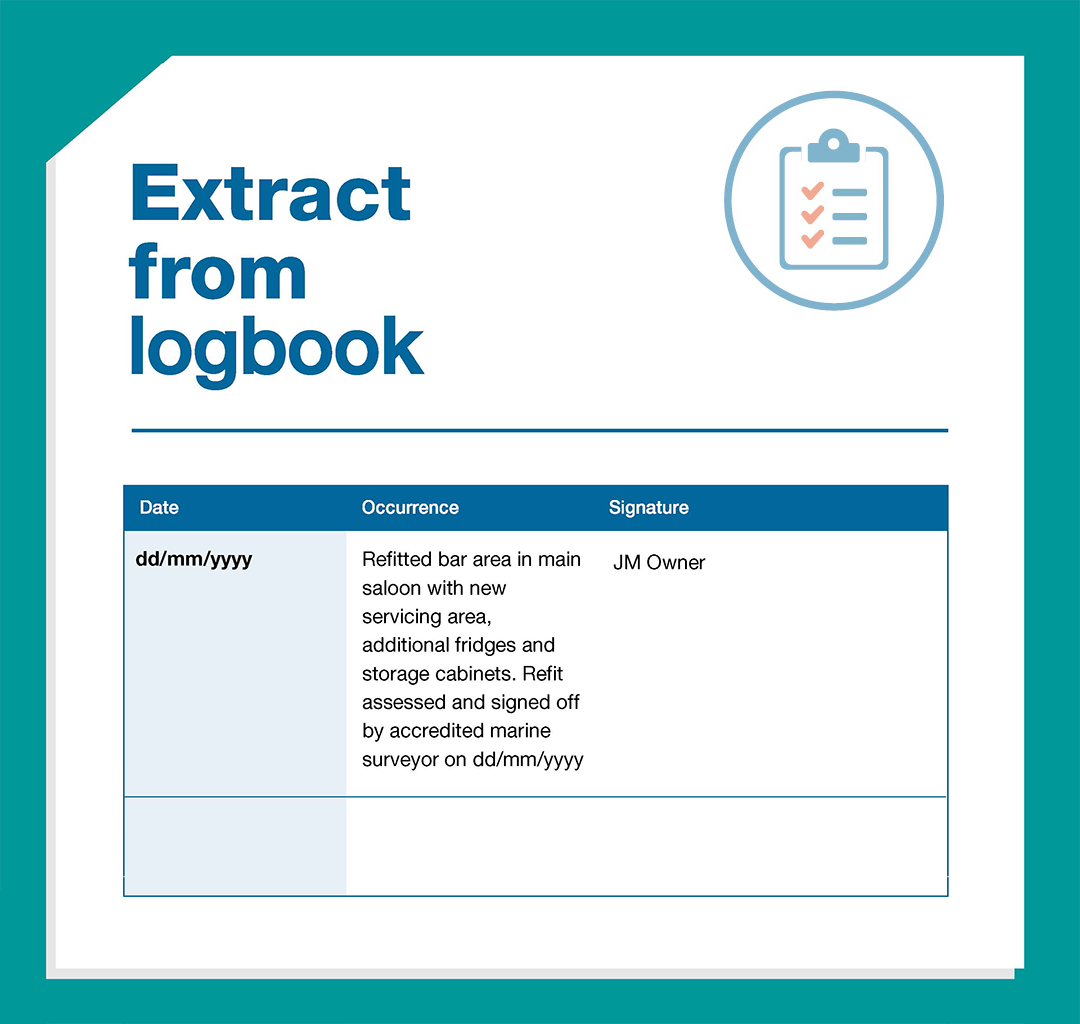
Having undertaken a risk assessment to identify risks to stability, the owner ensures that the refit of the bar area within the main saloon is recorded in the vessel logbook and reviewed by the master and crew. The master and crew can discuss any issues or concerns with the owner.
- Image description: Extract from logbook
Date Occurrence Signature dd/mm/yyyy Refitted bar in main saloon with new servicing area, additional fridges and storage cabinets. Refit assessed and signed off by accredited marine surveyor on dd/mm/yyyy J M Owner
When to seek expert advice
Talk to an accredited marine surveyor or naval architect about the effect on your vessel's stability:
- before making alterations that add significant amounts of topside weight - Remember that the higher the weight is placed the greater the effect. Weight added below the deck generally improves the vessel's ability to right itself but reduces freeboard and may decrease the vessel's range of stability.
- when the total weight of all modifications becomes significant - Weight added that is higher than the vessel's centre of gravity has a greater negative effect on stability. Removing weight below deck can also adversely affect stability.
- if there is a chance that the vessel’s lightship may change by more than 2%.
- if there is a chance that the vessel’s longitudinal centre of gravity may change by more than 4%.
If you don’t know, ask.
Download or print and share this guidance: How to meet vessel stability requirements PDF322.54 KB
Webinar
Watch a recording of the safety management system requirements webinar, presented on 19 March 2025. We discussed the new vessel stability requirements, and answered questions from industry.
Contact
Got a question about these requirements? Please contact us.
See what other updates you need to make to your SMS.