
In this edition
- Consultation now open on proposed changes to the National Standard for Commercial Vessels (NSCV) Part C4 – Fire safety
- Case study – conditions of accreditation
- Liferafts – are they correctly secured to the vessel?
- Electrical fire caused by a portable tool battery
- Fixed fire systems on transitional vessels
- Communicating with the Vessel Safety Unit
- Forms for conducting surveys
- Survey Matters – we want your suggestions
Consultation now open on proposed changes to the National Standard for Commercial Vessels (NSCV) Part C4 – Fire safety
Consultation is now open on proposed changes to the National Standard for Commercial Vessels (NSCV) Part C4 – Fire safety.
AMSA is seeking feedback on a range of proposed changes that aim to make the standard clearer, more practical, and better suited to today’s risks and technologies. NSCV C4 was last reviewed in 2018. These updates are aimed at making domestic commercial vessel (DCV) fire safety standards contemporary and aligned with today’s technology.
Key proposed changes
- Fire safety requirements for lithium battery technology
- Introduction of a “medium machinery space” category for machinery spaces over 10 m³.
- Expanding vessel machinery space definitions to explicitly include toys, tenders and equipment with petrol engines and/or lithium batteries
- Requiring interconnected photoelectric smoke alarms in accommodation and other relevant spaces on some vessels
- Providing alternative replacements for selected fire extinguishers
- Clarify fire resisting division standards and fuel tank boundary requirements
- Fire performance benchmarks for certain vessel fittings
- Clarify regulation of wood-fired heaters
- Editorial amendments resolving outdated references and providing clarity where required.
Who the changes affect
- owner/operators
- surveyors
- designers and builders of new construction domestic commercial vessels (DCV) and certain transitional vessels.
Have your say
If you’re a vessel designer or accredited marine surveyor, your feedback will help ensure the new standard is clear, consistent and relevant. You can read the draft and provide feedback on proposed changes until 6 February 2026.
Case study – conditions of accreditation
Surveyor decisions affect not only personal reputation but also the credibility of the National System. They must be treated seriously.
Regulatory framework
Under the Marine Safety (Domestic Commercial Vessel) National Law 2013, Reg 31 - Limits on the conduct of surveys, an accredited marine surveyor must not perform a survey of a domestic commercial vessel, or provide services in relation to such a survey:
- in a category of surveying in relation to which the surveyor is not accredited; or
- if the accreditation is subject to a limitation or condition on the work that can be performed by the surveyor in a category of surveying—in contravention of the limitation or condition.
Case study
In May 2025, AMSA received an application to add a 3B service category to a vessel with a 1B Certificate of Survey. This triggered transitional survey requirements under Marine Order 503 (Certificates of survey – national law).
AMSA approved the alternate survey, requiring:
- review of historical documents
- approved general arrangement drawings
- fire system verification
- stability assessment
- condition surveys.
By July 2025, survey recommendations were submitted.
Issues identified
AMSA's review found that one of the surveyors involved was subject to accreditation conditions preventing them from conducting surveys on this type of vessel. A desktop review revealed:
- Numerous deficiencies in the surveyor's work and vessel compliance.
- Misunderstanding of relevant legislation and standards.
- Recommendations outside the approved scope, including dangerous goods carriage and installation of petrol tanks, without applying correct transitional standards.
The vessel owner, relying on the surveyor's assessments, believed the vessel was compliant when it was not.
Outcome
- A breach report was raised with AMSA's compliance team.
- The surveyor was interviewed and issued a formal warning under AMSA's compliance policy.
- AMSA refused the vessel owner's application and advised them to engage an appropriately accredited surveyor to rectify defects before reapplying.
These outcomes carried serious financial and reputational consequences for the surveyor, the vessel owner and the profession.
The surveyor appears to have initially been engaged for a pre‑purchase periodic survey. When later asked to add the 3B service category, they incorrectly assumed this did not make the vessel transitional and continued with a periodic survey process.
Despite further vessel modifications triggering additional transitional requirements (e.g. addition of tanks, commencement of dangerous goods operations), the surveyor continued work outside their accreditation.
Lessons learned
Conducting survey work outside accreditation is an offence under Section 161 of the Marine Safety (Domestic Commercial Vessel) National Law Act 2012.
Recommendations made in these circumstances are invalid and may result in compliance action, including infringement notices or prosecution. Penalties range from fines (up to 200 penalty units) to imprisonment where safety risks are intentional.
Contravening a condition of accreditation is a strict liability offence, carrying a penalty of 60 penalty units (currently $19 800).
Surveyors must:
- Decline work outside their accreditation.
- Cease work immediately if scope changes beyond their accreditation.
- Inform the vessel owner and refer to an appropriately accredited surveyor.
- Seek guidance from AMSA (dcvsurvey@amsa.gov.au) if uncertain.
Continuing a survey to 'help' an owner or out of familiarity with a vessel is not doing the right thing. It exposes both surveyors and owners to regulatory, financial, and reputational risks.
Liferafts - are they correctly secured to the vessel?
Recent AMSA inspections have found liferafts installed incorrectly on some vessels - particularly where Hydrostatic Release Units (HRUs) were not fitted as required. This raises an important question: what are the correct requirements, and where can they be found?
For guidance, refer to the National Standard for Commercial Vessels (NSCV) – Part C, Section 7A: Safety Equipment – Life-Saving Equipment.
Specifically: Clause 4.5.2 – Stowage of liferafts sets out the requirements expected by the NSCV.
Key NSCV requirements for liferaft stowage
Continuous readiness
- Liferafts must be ready for immediate use.
- Two crew members must be able to launch each raft within 5 minutes.
- All liferafts must be in a position that enables them to be launched within 30 minutes with the vessel having up to:
- 10° trim (bow or stern)
- 15° list (port or starboard).
Stowage Conditions
- The painter line must be secured via a Hydrostatic Release Unit (HRU) to the vessel, not directly to the cradle or raft.
- Liferafts must be:
- positioned so they can float free if the vessel capsizes or sinks
- positioned to avoid obstruction of other life-saving appliances or escape routes
- positioned to launch directly down the vessel’s side into the water
- able to be transferred to either side of the vessel for launching (liferafts intended for throw-overboard launching)
- if stowed inboard from the side, stowage shall be such that one person, with a minimum of physical effort, can effect launching
- the stowage positions of liferafts, the launching devices (where fixed launching devices are used), and the areas of water into which the liferafts will be deployed shall be sufficiently illuminated (see also NSCV C5B Clause 4.7).
Special stowage cases
On vessels with limited deck space or reduced freeboard, the liferaft must be in a position so one person can launch it with minimal effort.
Prohibited locations
Liferafts launched from fixed launching devices must not be stowed:
- forward of the collision bulkhead
- where weather damage may occur (exposed or unsheltered positions)
- on or above cargo tanks containing hazardous substances
- near or aft of steep overhanging hull sections, which can prevent proper launching
- in a position that would result in the liferaft being in the vicinity of the vessel’s propeller or other propulsive device when lowered.
Hydrostatic Release Unit (HRU) – Function & Requirements
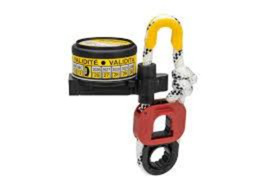
Normal operation:
- The Liferaft is secured to the vessel via the HRU and its painter attached to the HRU weak link.
- The HRU holds the raft securely during routine operations.
Activation (automatic release):
- When the vessel sinks to a depth of 1.5–4 metres, water pressure will activate the HRU’s mechanism.
- The HRU’s mechanism cuts the securing strap or releases the shackle, allowing the raft to float free.
Deployment:
- The raft floats to the surface while still attached by the painter line to the HRU weak link.
- As tension builds on the painter line, the raft inflation mechanism triggers, inflating the raft.
- The HRU weak link then breaks, separating the inflated raft from the sinking vessel.
Common issues observed during inspections:
- Painter incorrectly attached (e.g. to cradle or lashing point instead of HRU).
- HRU not properly aligned or installed upside down.
- Liferaft not securely lashed to prevent movement in heavy seas.
- Liferaft secured without an HRU.
- HRU out of date (check expiry date and manufacturer’s certification).
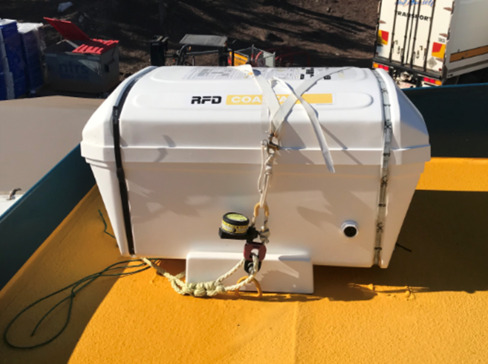
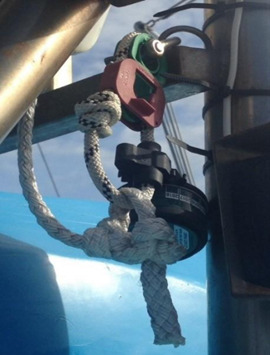
Good practice tips for AMS’s, owners, masters, and crew:
- Verify HRU expiry date and correct attachment points (clearly marked on most HRUs). All HRU’s come with fitting instructions.
- Check float-free capability – liferaft must release cleanly without snagging.
- Confirm accessibility in all weather, list, and trim conditions.
- Inspect lashings, cradles, and release arrangements for corrosion, chafing, or improper securing.
- Ensure clear signage and instructions are visible near the stowage location.
The videos below demonstrate the internal operation and correct installation of the units, note these are specific to the Hammar brand units. Please follow the specific instructions to the brand installed in your application.
Electrical fire caused by a portable tool battery
Recent inspections highlight the hazards of charging cordless tool batteries in areas surrounded by flammable materials.
This incident is currently under investigation with AMSA, details are still being confirmed.
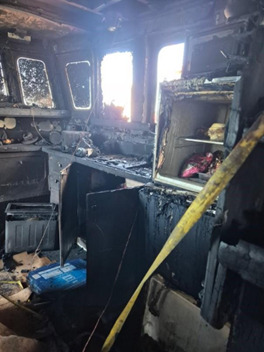
The incident occurred while the vessel was secured alongside a wharf, which fortunately limited the potential for escalation. A cordless tool battery had been placed on charge within the wheelhouse. During the charging process, it is believed the battery experienced an overheating event that progressed to ignition. This resulted in a localised fire and the damage evident in the accompanying photographs.
Although the vessel was attended and in a sheltered environment at the time, the circumstances highlight a significant risk. Had a similar event occurred while the vessel was at sea - particularly during periods when crew were resting below the wheelhouse - the consequences could have been far more severe, including the potential for loss of the vessel or serious injury to the crew.
This incident serves as an important reminder of the hazards associated with charging portable electrical storage batteries on board, especially in enclosed spaces or in proximity to flammable materials.

Consider the serious safety implications had this incident occurred at sea, particularly while crew were resting below the wheelhouse. The potential consequences could have been catastrophic.
As an accredited marine surveyor, please remain vigilant to the hazards associated with charging electrical storage batteries. Where unsafe or inappropriate charging practices are observed, you should ensure that owners and operators are advised of the associated risks and of the need to implement suitable control measures.
As an accredited marine surveyor, please remain vigilant to unsafe charging practices. Where observed, ensure owners and operators are advised of the risks and the need for suitable control measures, such as:
- Establishing dedicated battery‑charging areas
- Ensuring adequate ventilation
- Keeping charging equipment clear of flammable materials or ignition sources.
Find out more about reducing the risk of electrical faults and fires.
Fixed fire systems on transitional vessels
Under the National Law fire safety requirements depend on whether a vessel is classified as an existing, transitional, or new (Marine Order 503, Certificates of survey - national law 2018, Section 22).
For transitional vessels, AMSA requires evidence that any fixed fire detection and fixed fire-extinguishing system complies with NSCV Part C4 – Fire Safety. Even if the systems were originally installed under State or Territory requirements prior to 1 July 2013, they must still meet the NSCV C4 standards in Chapter 5 – Active fire protection measures.
Clause 5.4.3 of NSCV C4 requires that a fixed fire-extinguishing system be designed, assessed, manufactured, installed and tested in accordance with one of the standards listed in Table 14.
The term assessed is defined in clause 1.4, which refers surveyors to Chapter 18 – Assessment, installation and servicing of fire equipment. In particular, clause 18.1 requires the system to be assessed and verified against the applicable standards.
It is important to note that a service certification only confirms that regular maintenance and routine service checks have been carried out. It does not verify that the system complies with the design, installation and performance requirements of NSCV C4.
To meet the requirements of NSCV C4 Chapter 18, AMSA relies on evidence from a suitably qualified body or organisation with expertise in fire-extinguishing systems to confirm that the installed system complies with the relevant NSCV standards.
Accredited marine surveyors must therefore ensure that the evidence they provide demonstrates actual compliance, not just evidence of ongoing servicing.
Communicating with the Vessel Safety Unit
The Vessel Safety Unit (VSU) works closely with accredited marine surveyors. Learn how you can best engage with us to ensure timely and accurate responses.
Contacting VSU
- Technical and accreditation matters: dcvsurvey@amsa.gov.au
- Vessel applications: dcvapplications@amsa.gov.au
- AMSA Connect: 1800 627 484
VSU structure
VSU’s functions are broadly delivered across two core areas - Technical and Certification - each comprising specialised teams.
Technical (Head of Technical):
- Naval Architecture Team
- Surveyor / Audit Team
- Surveyor Accreditation Team
Certification (Head of Certification):
- Advisor, Vessel Certification (Canberra Office)
- Advisor, Vessel Certification (Coffs Harbour Office)
- Senior Certification Officers
- Certification Support Officers
How your query reaches VSU
All communication received through the listed email addresses is processed through our Customer Relationship Management (CRM) system.
Once received:
- your email is triaged, and a case is created.
- the case is assigned to the appropriate VSU team member for action.
- all correspondence is stored within the case until the matter is resolved.
- when the case is closed, an automated notification will be sent to you.
- cases may be re-opened if further clarification or follow-up is required.
To promote efficient case handling, please avoid using private email addresses when communicating with VSU. Using the official email channels ensures:
- your enquiry is responded to promptly, even when staff are on leave or acting in other roles; and
- your matter is correctly triaged and assigned to the relevant VSU team member.
Tips for effective communication
- Reply within the existing email thread — this keeps your correspondence attached to the correct case and helps our team respond more quickly.
- Avoid creating new emails for the same enquiry — this can duplicate cases and delay processing.
- Do not raise new, unrelated issues within an existing email chain — please start a separate email for each new subject to ensure it is triaged correctly.
Forms for conducting surveys
AMSA released updated survey report forms as part of the December 2024 revision of the Marine Surveyors Accreditation Guidance Manual (SAGM) Part 2, which commenced on 1 January 2025.
These revisions form a key component of AMSA’s broader program to improve the consistency, clarity and quality of survey documentation across the domestic commercial vessel fleet.
SAGM part 2 revisions allow accredited marine surveyors to use their own survey reporting forms, provided these forms contain sufficient detail.
For those accredited marine surveyors who choose to use AMSA developed forms, AMSA strongly encourages you to begin using the new forms for all surveys conducted. The updated reports reflect the revised structure and expectations set out in SAGM Part 2, including clearer prompts for required evidence, improved traceability of survey findings, and additional fields to support transparent recommendations to the National Regulator.
The new templates are designed to streamline surveyor workflows while ensuring that all required information is captured in a manner consistent with AMSA’s accreditation conditions.
Their use will support more efficient processing of certificates of survey, reduce the need for follow-up requests, and help maintain high standards of documentation across the industry.
Surveyors - find the updated forms for conducting or reporting on a survey or inspection.
Survey Matters – we want your suggestions
AMSA wants to ensure Survey Matters is relevant and useful for accredited marine surveyors, boat builders, class societies, and others involved in the survey of domestic commercial vessels.
We invite our readers to submit subject requests or ideas for future articles that would be of assistance to industry. Please send your suggestions to DCVSurvey@amsa.gov.au.