Showing 261 - 280 of 409 results for WA 0852 2611 9277 Biaya Untuk Memasang Moulding Kayu Dinding Daerah Cikarang Timur Kabupaten Bekasi
- Arthur Phillip, 21 May 1990On 21 May 1990 an extensive oil slick was sighted approximately four nautical miles south-east of Cape Otway by the pilot of a light aircraft. The Australian-flagged tanker Arthur Phillip was later established as the source of the spill.Last updated: 11/09/2020
- Speed and visibility play part in vessel collisionA charter vessel transiting between research sites at night collided with a stationary vessel. The stationary vessel’s master claimed to have an anchor light on, but the crew of the charter vessel stated they did not see any navigation lights. The master of the stationary vessel was preparing food on the vessel at the time and may have obstructed the anchor light view from the charter vessel’s crew. The master of the charter vessel was found to have been operating at high speed given the conditions (night operations). This also rendered the lookout ineffective.Last updated: 09/25/2023
- Containers overboardShipping containers lost from ships are a cause of pollution in the marine environment.Last updated: 03/05/2021
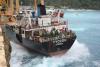 MV Tycoon, 9 January 2012On Sunday 9 January 2012, the cargo vessel the MV Tycoon broke free from its mooring at Flying Fish Cove, Christmas Island, and washed against the seawall and nearby cliff face. The ship had been loading phosphate at the time of the incident.Last updated: 11/09/2020
- Passenger vessel fire and evacuationA fire occurred on a passenger vessel in a busy harbour. The master and crew took immediate action and followed emergency procedures to disembark and transfer 73 passengers safely to another ferry. The vessel’s structural and fixed firefighting systems worked effectively to contain and extinguish the fire.Last updated: 03/14/2024
- Domestic commercial vessel inspectionsWe inspect domestic commercial vessels to ensure crew, vessel, and operational safety.Last updated: 08/01/2025
- Safety Lessons from Marine Incident Investigation (AMSA Report) – No.7 – May 2022Passenger sustains injury from poorly rigged gangway.Last updated: 05/25/2022
 Former South Australia police officer helps save maritime livesWatch the video of Mark Jacobs who has hung up his snorkel and fins to help save lives across 10 per cent of the Earth’s surface.Last updated: 05/03/2022
- Common deficiency issues under MARPOLThese are the deficiencies for MARPOL that our inspectors have found.Last updated: 07/13/2020
- Our registered training organisation (RTO): code 88033We offer nationally recognised units of competency in marine pollution response and incident management.Last updated: 07/07/2025
- Seafarer certification: annual statisticsUnderstand the state of the Australian maritime workforce. Find out how many domestic and international seafarers are certificated by AMSA to work in Australia.Last updated: 12/08/2025
- Coxswain grade 3 near coastalLearn about the Coxswain Grade 3 certificate, including the vessels it lets you operate, how to qualify, apply, or renew.Last updated: 07/02/2025
 Plastic Free July: AMSA’s action to reduce marine plasticsPlastic Free July encourages millions worldwide to reduce plastic consumption and find sustainable alternatives. As the national maritime regulator, we commit to reducing ocean plastics that harm our precious marine environment. To do this we work both internationally and at home.Last updated: 08/09/2024
- Certificate of equivalenceHow to obtain a certificate of equivalence.Last updated: 10/27/2020
- Our international engagementAustralia has an interest in ensuring that the ships which visit our ports and transit our waters are seaworthy, have competent crews, and are able to safely navigate through our sensitive marine areas.Last updated: 01/08/2025
- History of the National PlanOn 1 October 1973, the National Plan for Maritime Environmental Emergencies (National Plan) came into operation.Last updated: 10/03/2023
- Rope entanglement while setting cray pots results in person overboardOn 6 October 2022, two crewmembers were setting cray pots on the port and starboard side of a fishing vessel. During one setting, the crewmember’s foot (on the port side) became entangled in the cray pot’s rope dragging them over the side. The second crewmember raised the alarm and the master immediately stopped the vessel and instructed the crewmember to attach the line to the pot winch. The master and crewmember, having conducted regular emergency procedure drills, quickly raised the person overboard (PoB) via the pot winch, deployed the overboard ladder, and cut the rope. The PoB sustained some water in the lungs but was otherwise unharmed.Last updated: 02/07/2023
- Passenger seriously injured after falling down stairwellDuring a private charter a passenger fell down a stairwell and sustained serious injuries. The area around the top of the stairwell had a recess that reduced the floor area slightly and could be missed during movements. The stairs themselves were not found to be contributory to this incident. However, the spiral design proved problematic for providing post-incident medical assistance for the passenger. Any area that may present a safety risk to passengers onboard a vessel should be risk assessed, with appropriate control measures put in place to ensure passenger safety.Last updated: 05/30/2025
- Maritime casualty managementArrangements between government and industry under the National Plan for Maritime Environmental Emergencies to respond to shipping casualties.Last updated: 01/15/2025
- Passenger vessel flooded after access door was left openA passenger ferry was returning from its scheduled service when an unanticipated wave raised its stern and caused its bow to dive under the water. Water rushed over the bow and a significant amount came through the forward portside access door and into the passenger compartment. The master immediately reduced speed, which expelled most of the water overboard. The forward portside access door had been left open by a crew member who was attempting to alleviate sea sickness among some passengers. The action of leaving the door open during the voyage was contrary to the vessel’s survey requirements. Signage requiring the door to be kept closed when underway was reportedly not seen by crew members. This resulted in water entering the vessel creating a potentially unsafe situation.Last updated: 05/30/2025