Showing 401 - 420 of 1431 results for The Cruel Sea The Honeymoon Is Over
- Survey Matters September 2024In this edition we talk about Marine Surveyor Accreditation Guidance Manual – Part 2 , we include a Case Study about Compliance action on an AMS’s accreditation and decks on domestic commercial vesselsLast updated: 10/09/2024
- MARPOL Annex V exceptions and penaltiesThere are few exceptions to the prohibition of garbage discharge under MARPOL. Breaches can result in significant penalties.Last updated: 11/14/2023
- Poor risk assessment of river entrance bar crossing results in near misses with surfersA 2C rescue vessel was preparing to depart a river entrance bar with 11 people onboard. The observed sea state was a wave height (breaking) of 1.4 to 1.8 metres. The entrance bar had a moderate to high level of congestion of jet skis and surfboard riders positioned within the aids to navigation departure leads. The vessel came within very close proximity to surfers on 3 occasions whilst negotiating the breaking sea conditions. The vessel then broached upon a wave resulting in the vessel heeling to port and becoming unable to be controlled due to the force of the wave.Last updated: 08/29/2023
- Emergency towing vesselSince 2006, we have provided an emergency towing vessel in the Torres Strait and Great Barrier Reef to protect the marine environment.Last updated: 08/05/2024
- ‘Experience’ fails to prevent vessel capsize, which a proper risk assessment could have identified (safety lesson)A powered barge with a mounted crane became unstable and capsized in 3.5 metres of water during lifting operations of a concrete structure.Last updated: 12/22/2025
- Ferry-in-chains endorsementApply for an endorsement that allows you to command and operate the engines of a vehicular ferry-in-chains attached to the shore by cable.Last updated: 06/30/2025
- Survey Matters—March 2020In this edition we talk about survey procedures to verify radio installations on some vessels, we give tips for conducting a load line renewal survey, talk about simple exemptions and more.Last updated: 04/24/2020
- Historical focused inspection campaignsWe have conducted these inspection campaigns in the past, focusing on specific deficiencies and outcomes.Last updated: 10/26/2023
- Electronic visual distress signalsElectronic visual distress signals are not a substitute for conventional pyrotechnic flares.Last updated: 10/27/2020
- Annual report 2024–25Find out about AMSA’s performance and stay informed about our progress against key initiatives for 2024–25.Last updated: 10/27/2025
- Regulatory plan—five-year regulatory outlookThis five-year outlook of future action covers specific industry issues, international developments, priorities for standards, and legislative expiries.Last updated: 09/22/2020
 HF radiotelephone monitoring in AustraliaFrom 1 January 2022, AMSA will provide 24-hour nationwide monitoring of high frequency (HF) radiotelephone distress, urgency and safety communications in Australia.Last updated: 12/17/2021
- International Safety Management codeThe International safety management code (ISM code) governs the safe operation of ships and pollution prevention. We are responsible for issuing ISM code certification for Australian registered vessels, however AMSA has authorised recognised organisations to conduct this service.Last updated: 01/21/2021
- 6/2018—Limitation of sulphur emissions from cruise vessels while at berth in Sydney HarbourThe purpose of this marine notice is to inform cruise vessel masters and operators of AMSA’s policy on limiting sulphur emissions from cruise vessels[1] when at berth in the Port of Sydney Harbour.Last updated: 08/26/2019
- Handover procedures and distraction contribute to channel marker collisionOn 16 March 2022, a class 2B landing barge collided with a starboard channel marker. The investigation identified that the previous swing engineer did not inform the incoming engineer that the port main engine cooling water suction valve was shut. After getting underway, the engine began to overheat. This distracted the master from monitoring the vessel’s intended track. The vessel’s safety management system did not have an appropriate engineering handover procedure.Last updated: 07/25/2022
- Forms for international seafarersFind forms you might need to make sure you hold the right qualifications.Last updated: 06/28/2021
- Maritime Labour Convention—2019 Annual ReportThis report presents an analysis of Maritime Labour Convention (MLC) complaints, compliance and follow up actions undertaken in Australia.Last updated: 01/11/2024
- Enabling legislationAs a statutory authority, we work with the guidance of legislation.Last updated: 08/29/2024
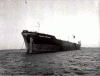 Princess Anne Marie, 14 July 1975On 14 July 1975 the Marine Operations Centre in Canberra was alerted that the oil tanker Princess Anne Marie had sustained a large crack in its hull approximately 300 miles off Western Australian.Last updated: 11/09/2020
 Professional growthWe are committed to nurturing your development and helping you reach your goals.Last updated: 11/13/2023