AMSA Connect phone services will be closed for the public holiday on Monday 8 June 2026, reopening on Tuesday 9 June 2026. Our search and rescue team will continue to operate during this time.
Showing 521 - 540 of 922 results for WA 0821 1305 0400 Konsultan Hydroseeding Stabilisasi Lereng Ogan Komering Ulu Sumatera Selatan
- Guide to our privacy policyA guide to our privacy policy.Last updated: 07/08/2025
- Long range identification and trackingAustralia can request and receive information on vessels travelling within 1000 nautical miles off its coast.Last updated: 04/22/2021
 Updated Marine Order 504 (Certificates of operation – national law) now availableUpdated Marine Order 504 now available.Last updated: 11/19/2024
- Domestic crew certification reforms starting 1 January 2023Regulatory requirements for certificates of competency, sometimes referred to as ‘tickets’, apply to thousands of Australians working across the domestic commercial vessel (DCV) industry.Last updated: 03/30/2022
- Workshop skill equivalent qualificationsHow to work out if your current qualifications can be used to support your application for a domestic certificate of competency.Last updated: 12/28/2022
 Our vision, mission and valuesWe are motivated by our mission and vision.Last updated: 10/30/2025
- MASTREP guide 2016The Modernised Australian Ship Tracking and Reporting System as described in Marine Order 63 Vessel Reporting Systems is used to track the location of vessels.Last updated: 08/03/2020
 Out now: Maritime Safety Awareness Bulletin — cargo securing of containersThe latest edition of the Maritime Safety Awareness Bulletin highlights the critical importance of proper cargo stowage and securing, following ongoing concerns about safety risks and compliance across industry.Last updated: 09/26/2025
- Obtaining approval to use an oil spill control agent at sea or on a shorelineUnder the National Plan for Maritime Environmental Emergencies, only those OSCAs listed on the OSCA Register are able to be used in a National Plan response.Last updated: 03/18/2024
- List of registered shipsSearch for a registered ship on the Australian General and International Shipping Registers.Last updated: 05/22/2026
- Scale G first aid kitsSurvey vessels in these classes are required to carry a Scale G first aid kit on board: 1D (with unberthed passengers), 1E (with unberthed passengers), 2D, 2E, 3D and 3E.Last updated: 12/23/2025
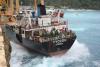 MV Tycoon, 9 January 2012On Sunday 9 January 2012, the cargo vessel the MV Tycoon broke free from its mooring at Flying Fish Cove, Christmas Island, and washed against the seawall and nearby cliff face. The ship had been loading phosphate at the time of the incident.Last updated: 11/09/2020
- MARS user guide 2021—submitting domestic commercial vessel survey reports to AMSAThis user guide sets out the process for the submission of surveys reports and recommendations to AMSA relating to DCV which are applying for, or hold, a Certificate of Survey, a Load Line Certificate, or an Exemption 40 approval.Last updated: 09/15/2021
- Overview map of C, D and E waters for TasmaniaThis map displays an overview of the specified C, D and E waters in Tasmania.Last updated: 12/21/2023
 BenefitsWe know it's not just about the salary, so we offer a range of attractive benefits.Last updated: 05/08/2025
- Intact stability requirements - C6AStandards for maintaining stability during day-to-day operations while the hull is intact.Last updated: 10/01/2024
- Trawler inpull winch reduces risk of person overboardThis safety lesson describes how experienced Queensland prawn trawl fisher, Tony Sterling, developed an inpull winch that pulls in both sides of the trawl gear at the same time. The winch has delivered major safety benefits because crew no longer need to go out onto the booms.Last updated: 08/29/2024
- Steps to getting a certificate of competencyFind out about the process of obtaining a near coastal certificate.Last updated: 05/06/2025
 Statement of regulatory approachDiscover how AMSA supports safe and sustainable maritime operations through fair, risk-based regulation. This statement explains our approach to safety, compliance, engagement and international obligations.Last updated: 10/20/2025
- Memorandum of understanding with the National Offshore Petroleum Safety and Environmental Management AuthorityWe have a joint memorandum of understanding (MOU) with the National Offshore Petroleum Safety and Environmental Management Authority. The MOU supports safety and environmental management for the offshore energy sector.Last updated: 11/17/2025