AMSA Connect phone services may have longer wait times on Monday 1 June 2026 while we operate with reduced staffing due to the Reconciliation Day Public Holiday in Canberra. Our search and rescue team will continue to operate during this time.
Showing 141 - 160 of 441 results for WA 0859 3970 0884 Biaya Pemborong Renovasi Plafon Kamar Tidur Murah Nguter Sukoharjo
- Prosecutions for ship sourced pollutionThere are laws against ship sourced pollution and those responsible may be prosecuted under state or territory legislation.Last updated: 11/14/2023
- 2025 quarterly domestic commercial vessel incident reportsThe information you provide in your incident report plays an important part in guiding the way we improve maritime safety for everybody on the water. By reporting marine incidents to us, you are also meeting your reporting obligations under Australian laws.Last updated: 03/16/2026
- 2021 monthly domestic commercial vessel incident reportsThe information you provide in your incident report plays an important part in guiding the way we improve maritime safety for everybody on the water. By reporting marine incidents to us, you are also meeting your reporting obligations under Australian laws.Last updated: 05/09/2022
 National Maritime WHS Regulators ForumThe National Maritime Work Health and Safety (WHS) Regulators Forum is a collaborative platform for discussing maritime workplace health and safety. Its main aim is to improve safety for domestic commercial vessels.Last updated: 03/25/2024
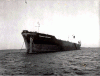 Princess Anne Marie, 14 July 1975On 14 July 1975 the Marine Operations Centre in Canberra was alerted that the oil tanker Princess Anne Marie had sustained a large crack in its hull approximately 300 miles off Western Australian.Last updated: 11/09/2020
- DCV Safety Alert 01/2023 – Safe Access to Domestic Commercial VesselsThis safety alert aims to raise awareness of the risk involved with getting on and off domestic commercial vessels.Last updated: 10/16/2025
- 2023 monthly domestic commercial vessel incident reportsThe information you provide in your incident report plays an important part in guiding the way we improve maritime safety for everybody on the water. By reporting marine incidents to us, you are also meeting your reporting obligations under Australian laws.Last updated: 02/23/2024
- Exercise Barossa—Adelaide 11 June 1998Exercise Barossa was a biannual oil spill response exercise conducted in Adelaide under our National Plan to Combat Pollution of the Sea by Oil and Other Noxious and Hazardous Substances.Last updated: 03/14/2025
- 2024 monthly domestic commercial vessel incident reportsThe information you provide in your incident report plays an important part in guiding the way we improve maritime safety for everybody on the water. By reporting marine incidents to us, you are also meeting your reporting obligations under Australian laws.Last updated: 01/28/2025
- Fire prevention and fire fighting—basicAMSA approved training organisations currently delivering the fire prevention and fire fighting—basic training.Last updated: 10/27/2020
- Personal survival techniquesAMSA approved Training Organisations currently delivering the personal survival techniques for international qualifications.Last updated: 10/28/2020
- Security awareness trainingAMSA approved training organisations currently delivering the security awareness trainingLast updated: 10/27/2020
- Certificates of survey (CoS)Generally, vessels are required to have a certificate of survey to operate as a commercial vessel in Australia.Last updated: 10/30/2025
- Scale D medical cabinetSurvey passenger vessels with offshore operations (Class 1B) are required to carry a Scale D medical cabinet and a Scale F first aid kit on board.Last updated: 12/23/2025
 Watch now: new safety management system requirementsAMSA’s second safety management system (SMS) webinar focused on upcoming changes to SMS requirements.Last updated: 03/27/2025
- Scale E medical cabinetSurvey passenger vessels with offshore operations Class 1C (with berthed passengers), 2B and 3B, are required to carry a Scale E medical cabinet and a Scale F First aid kit on board.Last updated: 12/23/2025
 Watch our first SMS webinar: fatigue risk managementAMSA recently hosted the first webinar in our safety management system (SMS) series, focusing on fatigue risk management.Last updated: 03/04/2025
- Residual current devicesResidual current devices minimise the risk of a person receiving an electric shock or being electrocuted when using plug-in electrical equipment on board vessels.Last updated: 10/16/2023
- Maritime Law Association of Australia and New Zealand Annual Conference 2023AMSA is pleased to be a sponsor of the 2023 annual conference of the Maritime Law Association of Australia and New Zealand (MLAANZ), 4-6 October.Last updated: 10/09/2023
- 2018 monthly domestic commercial vessel incident reportsThe information you provide in your incident report plays an important part in guiding the way we improve maritime safety for everybody on the water.Last updated: 05/09/2022