
Showing 181 - 200 of 607 results for WA 0812 2782 5310 Jasa Borongan Plafon Akustik Board Tingkir Salatiga
- Exemption 17 - Marine Safety (Great Barrier Reef Region and Torres Strait zone)This exemption allows people to work as a master or chief mate on a vessel operating in the Great Barrier Reef or Torres Strait Zone or from a Queensland island without the required certificate.Last updated: 12/23/2025
- Supervisory definitionsLearn the differences between general and direct supervisionLast updated: 02/29/2024
 National Maritime WHS Regulators ForumThe National Maritime Work Health and Safety (WHS) Regulators Forum is a collaborative platform for discussing maritime workplace health and safety. Its main aim is to improve safety for domestic commercial vessels.Last updated: 03/25/2024
- Exemption 40 - (Operational area) DeterminationThis determination identifies the parts of operational area C in which a vessel approved under Exemption 40 may operate.Last updated: 07/01/2025
- Pollution from fishing vesselsYou have a responsibility not to pollute the sea, and to be aware of the laws about oil and garbage pollution from vessels, including fishing vessels.Last updated: 08/13/2020
- Consultation—Maritime high frequency (HF) radiotelephone in Australia 2019We want your feedback on the proposal to cease high frequency (HF) radiotelephone monitoring of distress and safety communications in Australia.Last updated: 09/13/2023
- Summary of complaints for COVID-19 sea service extensionsThe following statistics relate to the complaints received by AMSA since we issued Marine notice 04/2020 (expired 30 September 2020) and Marine notice 10/2020 (expired 28 February 2021).Last updated: 11/14/2023
- Crewing guidance for domestic commercial vesselsGuidance on crewing of domestic commercial vessels as per Schedule 1 Clause 6 - Appropriate crewing and Clause 8 - Minimum crewing of Marine Order 504 (Certificates of operation - national law) 2024. Schedule 1 applies to all vessels other than class 4 vessels.Last updated: 10/16/2025
- How Australian seafarers use task booksIf you are an Australian seafarer, you can use an AMSA approved task book to record your sea service, training and experience on board a vessel.Last updated: 12/28/2022
- Fuel oil consumption dataAll ships of 5,000 gross tonnage and above engaged in international voyages must collect data on fuel consumption, distance travelled and hours underway.Last updated: 11/07/2024
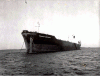 Princess Anne Marie, 14 July 1975On 14 July 1975 the Marine Operations Centre in Canberra was alerted that the oil tanker Princess Anne Marie had sustained a large crack in its hull approximately 300 miles off Western Australian.Last updated: 11/09/2020
- Coastal pilot trainingWe are responsible for approving coastal pilotage training providers and courses.Last updated: 03/09/2025
 AMSA update—2024 editionsRead previous AMSA update editions from 2024Last updated: 02/19/2025
- Collisions between vessels and marine faunaLook out for marine fauna and report any collisions.Last updated: 12/02/2025
- Trawler inpull winch reduces risk of person overboardThis safety lesson describes how experienced Queensland prawn trawl fisher, Tony Sterling, developed an inpull winch that pulls in both sides of the trawl gear at the same time. The winch has delivered major safety benefits because crew no longer need to go out onto the booms.Last updated: 08/29/2024
- Consultation feedback report—simplified equipment lists for small fishing vesselsStreamlined equipment lists for non-survey fishing vessels operating within 2 nautical miles of land in specified warm waters and in beach fisheries within 200 metres of land.Last updated: 04/04/2023
- Exemption 10 - Marine Safety (Operation of fishing vessels)This exemption allows eligible people to work as a master on a commercial fishing vessel in parts of Queensland without the required certificate of competency.Last updated: 12/23/2025
- Exemption 22 - Marine Safety (Bareboats)This exemption allows people to operate a bareboat without the required certificate of competency.Last updated: 12/23/2025
- AMSA mandated practical assessmentsGeneral and practical information about the AMSA mandated practical assessment (AMPA), including how to perform the assessment.Last updated: 11/06/2023
- Exemption 24 - Marine Safety (Emergency service vessels)Exemption 24 allows volunteer emergency services to crew their vessels using trained volunteers without a certificate of competency.Last updated: 10/03/2025