
Showing 181 - 200 of 575 results for WA 0852 2611 9277 Jasa Bongkar Pasang Plafon Mewah Modern Makasar Jakarta Timur
- 2023/07 - Guidance for the safe carriage of battery powered vehicles on shipsThis marine notice advises ship operators and owners of the hazards of transporting battery-powered electric vehicles (BEVs).Last updated: 07/18/2025
- Consultation—Draft Marine Order 44—(Safe containers) 2019Consultation on Marine Order 44 closed on 1 March 2019.Last updated: 11/29/2024
 National Maritime WHS Regulators ForumThe National Maritime Work Health and Safety (WHS) Regulators Forum is a collaborative platform for discussing maritime workplace health and safety. Its main aim is to improve safety for domestic commercial vessels.Last updated: 03/25/2024
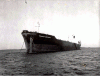 Princess Anne Marie, 14 July 1975On 14 July 1975 the Marine Operations Centre in Canberra was alerted that the oil tanker Princess Anne Marie had sustained a large crack in its hull approximately 300 miles off Western Australian.Last updated: 11/09/2020
- Survey Matters—December 2019In this issue we bring you information about a new electrical standard, welding requirements for some vessels, how many watertight doors the NSCV allows and more.Last updated: 10/13/2025
- Parasailing safety guidanceWe have released some safety guidance for commercial parasailing operators. Parasailing vessels are considered domestic commercial vessels under the National law.Last updated: 10/25/2023
 AMSA promotes seafarer welfare during recent Seafarers’ Welfare ConferenceAMSA presents at Mission to Seafarers Australia’s Seafarers’ Welfare ConferenceLast updated: 08/05/2024
- Should we use dispersants?Dispersants can be effective response tools. Use of dispersants is dependent on many factors including timing, properties of the oil, and logistics.Last updated: 10/20/2023
- Exercise Constant Bearing 2017 evaluation reportThe 2017 National Plan exercise ‘Exercise Constant Bearing’ was held in Adelaide, South Australia, from 5 to 7 December. A full overview of the exercise including evaluation insights and recommendations, can be found in this report.Last updated: 11/09/2020
- New assets for Gladstone Port CorporationIn 2017 Gladstone Port Corporation (GPC) announced the arrival of its newest pilot vessel and the commencement of a new helicopter service contract.Last updated: 08/13/2020
- 2022/01 — MARPOL Annex V (Garbage) DischargesAustralian legislative requirements preventing pollution from discharge of garbage.Last updated: 04/14/2025
- Survey Matters—April 2020In the April edition we tell you what we are doing to support our industry during the COVID-19 period, we provide information about passive fire safety measures, give guidance on inspecting internal buoyancy or sealed internal hull voids, and more.Last updated: 10/19/2025
- Exemption 40 - (Operational area) DeterminationThis determination identifies the parts of operational area C in which a vessel approved under Exemption 40 may operate.Last updated: 07/01/2025
- 2018/05 — Pre-loading cargo information for livestock vesselsThis marine notice is to remind livestock shippers, vessel owners and operators, and the masters of livestock vessels of their obligations to provide and use accurate information in the calculation of vessel stability.Last updated: 01/10/2025
- Asbestos on shipsThis information is to draw the attention of ship owners and operators to the ongoing prohibition of asbestos on ships, noting that Australian law requires operators to take all reasonable steps to protect the health and safety of employees and contractors while at work.Last updated: 07/12/2024
- Superseded standards for commercial vesselsOn this page you can find copies of previous editions and amendments to the NSCV.Last updated: 10/01/2024
- Survey Matters December 2024In this edition we talk about Lightship declarations and the law, new surveyor accreditation guidance manual part 2 now available and electrical issues able to be identified by non-electrical periodic surveyors.Last updated: 02/12/2025
- Dispersant responseChemical dispersants are one of the response tools available during oil spill responses.Last updated: 03/07/2025
- Commercial fishing vessels travelling in the exclusive economic zoneDomestic commercial fishing vessels may transit between the exclusive economic zone (EEZ) around Norfolk island and the Australian mainland.Last updated: 11/21/2022
- Unpowered bargesUnderstand the regulatory requirements under the Marine Safety (Domestic Commercial Vessels) National Law 2012 (National Law) for unpowered barges.Last updated: 07/15/2025