
Key safety messages
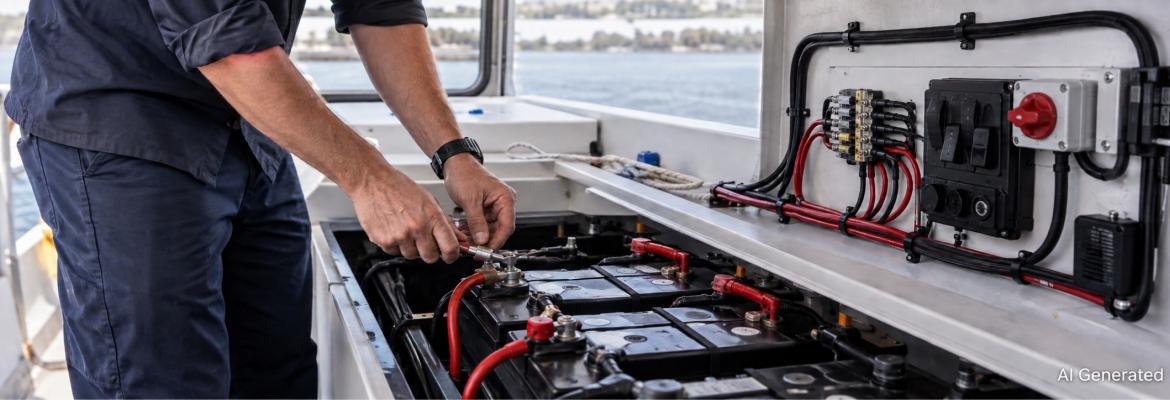
- Get wiring, connections and batteries inspected regularly as part of your maintenance plan.
- Make sure lithium-ion (Li-ion) battery installations meet the Australian Standard AS3004.2.
- A competent professional must install batteries and conduct inspections.
- Develop a procedure to manage portable Li-ion battery charging risk.
- Charge devices in open, ventilated spaces. Disconnect when fully charged.
On this page:
Lithium-ion batteries
Li-ion batteries are becoming more popular because they have higher energy storage capacity for a given weight than lead-acid batteries. Certified, high-quality Li-ion batteries are generally very stable. However, they can pose risks, especially if they're not used as specified by manufacturers.
Requirements under the national law
What domestic commercial vessel (DCV) owners and operators need to do to comply.
Li-ion battery installations up to 30 kWh
- You must take steps to ensure the safety of a vessel and equipment under general safety duties. This means considering fire prevention and battery management systems.
- New vessels with Li-ion batteries, or vessels changing from lead-acid to Li-ion must comply with NSCV Part C5B and AS3004.2. An accredited marine surveyor must submit AMSA form 564: Extra low voltage electrical initial survey report
Li-ion battery installations over 30 kWh
- A vessel with a battery installation exceeding 30 kWh of storage capacity is likely to be considered a 'novel vessel'. These vessels require higher safety assurance. Contact AMSA to make sure required standards are applied.
Hazard: thermal runaway
Battery thermal runaway leads to fire and the release of toxic and explosive super-hot gases and compounds.
Causes
- Internal short circuits – caused by failure of the separator between battery components.
- Overcharging – due to faulty charger or failure of a battery management system (BMS).
- External short circuits – resulting from damaged wiring or ingress of moisture.
- Overheating – caused by high ambient temperatures, proximity to heat.
- Mechanical damage – due to impacts, vibration, improper installation.
Battery types and fire risk
General rule: higher energy density = higher thermal risk
| Chemistry | Typical vessel usage | Energy density | Risk |
| Lithium titanate oxide (LTO) | Fast-charging ferries, tugs and specialised commercial vessels | Very low | Lowest risk |
| Lithium iron phosphate (LFP) – most common | House batteries, solar storage, propulsion systems | Low-moderate | Lower-moderate risk |
| Lithium nickel manganese cobalt oxide (NMC) | E-bikes, power tools, portable equipment, some propulsion systems | Moderate-high | Moderate-high risk |
| Lithium nickel cobalt aluminium oxide (NCA) | High-range propulsion systems and high-capacity battery packs | High | High risk |
| Lithium cobalt oxide (LCO) | Phones, laptops, tablets, cameras | Very high | Highest risk |
Any lithium battery can catch fire if damaged, incorrectly installed or improperly charged. All battery types should have appropriate safety measures in place.
Best practices
- Consider the whole system when installing Li-ion batteries on a vessel.
- Select batteries from a reputable manufacturer.
- Ensure installation by a competent person according to the AS3004.2. Consider applying requirements in the consultation draft of NSCV Part C4 Fire Safety (Chapter 18).
- Use a BMS that provides the functions listed in the Australian Standard 3004.2.
- Install batteries in a fireproof container constructed to a recognised international standard.
- Install venting to ensure flammable and toxic gases are directed overboard and clear of air intakes, muster stations and safety equipment.
- Follow manufacturer’s instructions for care, installation and maintenance in addition to the applicable standards.
- Regularly check battery condition and charging performance.
- Monitor batteries when charging for signs of failures such as overheating, smoke, fire or mechanical damage.
- Install an off-gas, heat and smoke detection system in the lithium battery space.
Lessons learned: In 2023, a lithium-ion battery system caused an explosion on a charter fishing vessel.
Portable device charging
Phones, tablets, power banks, cameras, e-bikes and power tools are often charged on board. Damaged or unattended batteries in these devices have the highest risk of thermal runaway. They can catch fire without warning.
Common hazards
- Overheating: Batteries can enter an uncontrollable, self-heating state. This can cause the release of gas, fire or possibly an explosion.
Damage: Portable batteries that have been dropped or impacted may fail during charging or when being used.
Warning signs
Stop charging immediately if you notice:
- swelling
- unusual heat
- smoke
- sparks
- leaking fluid
- unusual smells
- cracking or popping sounds.
Best practices
- Develop a procedure for safely charging Li-ion powered devices on board. This should consider the risk of a thermal runaway event including venting of toxic and flammable gases and compounds.
- Consider installing a dedicated charging cabinet, manufactured to an appropriate standard The cabinet should include temperature rise detection, a way to extinguish fire without opening doors, and ventilation of off-gassing to prevent overpressure and build-up of explosive gases.
- Any charging cabinet should be suitably insulated to prevent spread of fire from a battery along with suitable protection from explosion.
- Charge batteries away from accommodation spaces and clear of any flammable items or sources of ignition.
- Monitor batteries while charging and disconnect when fully charged. Consider setting timers as a reminder to unplug devices.
- Remove damaged batteries from your vessel and dispose immediately according to manufacturer's instructions.
- Never leave Li-ion batteries or portable devices in hot places or direct sunlight.
- Inspect batteries prior to charging. Do not charge if there are any signs of damage, or if the battery is hot.
- Develop an emergency plan for a Li-ion fire. Ensure all crew members know exactly what to do.
Lessons learned: In 2019, 34 people died and the passenger vessel Conception was lost when it caught fire. Unsupervised batteries being charged was one of the likely ignition sources.
Lead-acid batteries
Lead-acid batteries are the most common battery type found on board vessels.
Common hazards
- Corrosion: Acid leaks can corrode nearby components and the hull.
- Hydrogen gas emission: Gas is released during charging, which poses an explosion risk.
Best practices
- Address the risk of explosion from lead-acid batteries as part of your safety management system.
- Store batteries within an acid resistant container with the required ventilation. Ensure that the terminals are covered and batteries secured.
- Regularly inspect batteries as part of your planned maintenance schedule.
- Make sure sources of ignition or flammable materials aren't near the charging location.
- Maintain electrolyte levels (some batteries).
- Ensure batteries and electrical systems are installed by a competent person and meet the relevant Australian Standard.
Wiring
All electrical systems have common components such as wiring and connectors. Hazards can result in fire or malfunction.
Common hazards
- Physical damage to wiring insulation: This may be caused by chafing, UV light damage or exposure to chemicals.
- Wet environments: The maritime environment exposes electrical systems to moisture. This increases the chance of short circuits and corrosion.
- Ageing or poorly installed wiring.
- Overloaded circuits: This can result in overheating.
Best practices
- Address the risk of fire from electrical installations as part of your safety management system.
- Regularly inspect wiring and connections for wear, corrosion, and security of connections.
- Ask a licensed electrician to inspect and resistance test your vessel’s electrical cabling and connections. Do this as part of your planned maintenance schedule.
- Select wiring for the correct current rating, taking into account the voltage drop. The size of the wiring may need to be increased.
- Ensure installation by a suitably competent person in accordance with the Australian Standard.
Take action
Address the risk of fire from batteries, portable device charging and electrical installations in your safety management system.
Remember: DCVs are 'workplaces' under state and territory workplace health and safety laws. This means additional electrical requirements may apply. Find out more about work health and safety on DCVs.