
In this edition:
- Record‑keeping is more than a compliance exercise
- In-field audits
- Capsize of the Ocean King: stability lessons for surveyors
- How to notify AMSA of an engine change
- Fitting hoppers to fishing vessels — survey and certification considerations
- Ultrasonic thickness measurement of metallic vessels is now available
- Survey Matters — we want your suggestions
Record-keeping is more than a compliance exercise
Good record‑keeping is often viewed as an administrative requirement, but for surveyors and vessel operators it is far more important than that.
Accurate, complete and well‑maintained records are fundamental to demonstrating compliance, supporting professional judgement, and protecting all parties when questions or issues arise.
- More on Record-keeping requirements
Why records matter
Survey records form the evidence base for survey decisions and recommendations. They show how standards were applied, what was inspected, and how conclusions were reached. Clear, defensible records support consistency across the survey and certification scheme and provide confidence that survey outcomes are sound and reliable.
For surveyors, good records are also a key form of professional protection. In the event of a complaint, audit or incident investigation, records are often the primary means of demonstrating that surveys were conducted competently and in accordance with the Marine Surveyors Accreditation Guidance Manual (SAGM). An otherwise successful survey can be undermined if it can’t be reviewed and audited due to incomplete or unclear records.
Benefits for operators
For vessel owners and operators, good records provide clarity about:
- the condition of the vessel at the time of survey
- any non‑conformances identified and actions required
- the basis on which certificates are issued or renewed.
Clear documentation helps operators understand their obligations and reduces the risk of misunderstandings or disputes later.
What AMSA looks for
During audits, AMSA reviews records to assess whether survey processes are being applied consistently and whether decisions are supported by objective evidence. This includes survey reports, retained documentation, and records of non‑conformances and corrective actions.
A shared responsibility
Good record‑keeping supports safety, transparency and trust across the system.
Rather than being seen as a compliance burden, it should be recognised as an essential part of professional survey practice—protecting surveyors, informing operators, and underpinning confidence in the accreditation framework.
Top 5 record-keeping tips
- Record the “why,” not just the outcome: Document how you reached your decision, including references to standards and any professional judgement applied. This will also help you recall the rationale if required later when key details might be forgotten.
- Keep evidence with the recommendation: Retain supporting material such as photos, calculations, approvals, certificates and correspondence so decisions can be verified later.
- Be clear and specific with non‑conformances: When raising an AMSA 586, describe the issue precisely, link it to the applicable requirement, and clearly state the corrective action required.
- Close the loop on corrective actions: Ensure follow‑up actions are recorded and closed out in MARS or retained records. Open or unresolved items are a common audit finding.
- Think ahead to audits and complaints: Ask yourself: If this decision is reviewed in the future, will my records clearly show what I did, why I did it, and that it met the required standards?
In-field audits
Through the 2025–26 pilot program, AMSA has been assessing in-field audits (in-field meaning either office audits or on-site audits onboard a vessel) as a means of complementing our existing desktop reviews and gaining a more direct understanding of how survey decisions are made, documented, and supported. Early findings indicate that this practical form of oversight plays a significant role in enhancing consistency, accountability, and safety across the domestic commercial vessel sector.
- More on In-field audits
Why AMSA is expanding audits
Auditing has long formed part of AMSA’s oversight of surveyors under the national law framework and SAGM. The purpose of these audits is to verify that surveyors are complying with the conditions of their accreditation and that the scheme is achieving the safety outcomes it is intended to support.
In-field audits also enable AMSA to apply regulatory oversight in a proportionate and risk-based manner. This ensures that regulatory effort is focused on surveyors and survey activities presenting the highest safety and compliance risks, while also forming part of the broader suite of compliance and assurance measures available to AMSA.
Supporting desktop review with direct observation
AMSA’s audit approach is risk-based. Desktop reviews remain an efficient method for examining records, recommendations, and compliance history, particularly where broad oversight across the accreditation scheme is required. However, desktop reviews do not always provide insight into how standards are interpreted in day-to-day practice or how professional judgement is applied in operational settings.
This is where in-field audits provide additional value. Office audits enable AMSA to review file management systems, supporting documentation, and the basis for recommendations within the surveyor’s normal working environment. On-site audits, by comparison, are intended to observe the surveyor’s processes during live operations. The vessel itself is not the focus of the audit; it simply provides the practical context needed to observe the surveyor undertaking a survey. The objective is not to re-survey the vessel, but rather to assess how the surveyor conducts the survey, documents decisions, and substantiates conclusions in real time.
When an in-field audit is needed
In-field audits are most likely to be used when desktop reviews, MARS assessments, major audits, complaints or earlier assurance work points to areads needing closer examination. This may include repeated gaps in documentation, unresolved corrective actions, or concerns that a surveyor’s records do not fully reflect actual practice.
AMSA may also undertake in-field audits of surveyors from time to time, both to test the robustness of its broader risk model and to check that regulatory attention is reaching the right parts of the scheme.
What the pilot programme showed
Participation in the pilot was voluntary, and four surveyors took part. AMSA carried out the pilot audits as office-based reviews in the participants’ own working environments, providing a practical way to test the procedure before moving to the added complexity of an on-site observation. The audits were conducted in a cooperative and constructive manner. They proved valuable in demonstrating how face-to-face discussions can clarify issues and provide greater insight into how records, systems, and survey decisions integrate in practice.
Why the findings matter
One of the key findings from the pilot program was the value of direct engagement. Meeting with surveyors in person provided AMSA with a more dynamic and effective means of exploring issues as they arose. It allowed a clearer understanding of the context surrounding the documents under review. In practical terms, this resulted in a stronger evidence base for oversight activities and a more accurate assessment of whether concerns identified through documentation reflected broader issues in practice.
The pilot also enabled AMSA to further refine the audit process. It identified where the office-audit model was operating effectively, highlighted areas requiring further development, and provided insight into how participating surveyors experienced the process.
Feedback from the pilot indicates that in-field audits can deliver benefits beyond the identification of compliance issues. It also helps build a shared understanding between the regulator and industry practitioners, supporting a more informed, consistent and effective assurance process.
What comes next
The model continues to evolve, particularly in relation to the development and implementation of future on-site audits. While more work in this area is required, current indications are that in-field audits are a valuable tool, with significant potential to support education, continuous improvement, and reinforcement of regulatory expectations.
AMSA intends to trial on-site audits in a similar fashion to the initial in-office audits to refine processes and gain greater insight on how to best incorporate this capability into the audit scheme.
We sincerely thank those surveyors who volunteered their time to participate in the pilot program.
Capsize of the Ocean King: stability lessons for surveyors
On 2 December 2024, Ocean King, a 18.3 metre prawn trawler capsized in calm waters while approaching a berth on the Gold Coast. The master and deckhand escaped with minor injuries.
AMSA’s marine incident investigation concluded that the vessel was unlikely to capsize in calm water under compliant loading conditions. However, a combination of reduced stability margins, tank management issues, free-surface effects and incomplete stability documentation created a condition in which capsize became possible.
- More on stability lessons for surveyors
Key stability factors
The marine incident investigation found several factors may have contributed to the loss of stability, including:
- the bulb ballast tank was significantly below the required level
- fuel crossover valves were open, allowing fuel to shift between tanks as the vessel heeled
- a relatively small amount of water in the freezer room would produce a very large free-surface effect as the vessel heeled
- the vessel had a shallow aft deck edge, reducing its reserve stability at relatively low angles of heel.
The investigation also noted that the vessel’s design had been influenced by Queensland fisheries effort rules, which use hull dimensions to calculate fishing effort (quota). The rules may inadvertently create an incentive to minimise hull depth, thereby reducing stability margins.
Stability book issues
AMSA’s review of the approved stability book identified several concerns. Mandatory NSCV C6C Annex F loading conditions were missing or altered, including lightship, no-catch arrival and 20% catch arrival conditions. The stability book also relied heavily on operational controls, including complex tank management procedures to achieve compliance with the applicable criteria.
Operational controls must be able to be readily implemented by the master considering their required level of competence. Overly complicated operational controls raise the risk of human error. In accordance with their general safety duties, designers should collaborate with the owner / operator to determine the feasibility of any operational controls placed on a vessel to meet the applicable stability criteria.
What surveyors are required to check
Surveyors must ensure that stability documentation:
- includes all mandatory NSCV C6C Annex F load cases
- does not modify required load cases through operational restrictions
- properly accounts for free-surface effects, including partially filled tanks
- considers foreseeable fishing operations, including cod-end lifts and snag loads
- identifies the effect of fuel crossovers, ballast arrangements and other systems that may shift weight or create free surface effects
- does not rely on complex tank management or procedural controls to make an otherwise marginal condition compliant.
Key message
For surveyors, the key lesson is that stability compliance must be demonstrated against the applicable mandatory load cases, using conservative and credible assumptions. When writing and/or assessing a stability book surveyors should use responsible engineering practice. This includes avoiding unrealistic operational controls such as complex loading or tank management, speed restrictions when turning, or adjusting the specific gravity of fluids to get a non-compliant vessel “over the line”. Operational controls may support safe operation, but they should not be used to avoid, modify or substitute the stability criteria the vessel is required to meet.
A surveyor’s role under the National Law is to verify that a vessel complies with the applicable stability criteria. In the case of the Ocean King, the outcome could have been far more serious had the capsize occurred offshore during fishing operations rather than near the shore. The absence of serious injury does not however lessen the importance of the stability and survey lessons arising from this incident.
How to notify AMSA of an engine change
To notify AMSA of an engine change, applicants must now submit an application to amend the relevant vessel certificate or approval. This replaces the previous manual process using the Notification of Change of Engine (AMSA Form 1847), which is no longer in use.
Under the former process, engine change notifications required submission of Form 1847 along with a supporting report from an Accredited Marine Surveyor (AMS). This report confirmed that the engine change did not affect the vessel’s structural or stability design assumptions or calculations and did not alter other vessel systems. Depending on the modification, additional supporting documentation may be required, such as:
- a lightship check
- structural plans for modifications
- engineering reports.
The current process is completed through the relevant application form for the vessel type:
- Certificate of survey (Form 521)
- Class C restricted operations (Form 523)
- Non-survey vessel (Form 579)
Within the applicable form, select “Make a change” and then choose “Update engine details” from the available options.
There is no fee associated with updating engine details.
- More on engine change requirements
The requirement to provide engine details and supporting reports or recommendations remains unchanged. Applicants must still provide evidence that the engine change does not invalidate the vessel’s structural or stability assumptions and calculations. Any relevant supporting documentation must now be uploaded as part of the application. This may include:
- surveyor reports or recommendations
- lightship verification documentation
- structural modification plans
- engineering assessments.
All supporting documentation should be uploaded at the time the application is submitted.
If the certificate of survey currently has incorrect vessel engine details the above procedure needs to be followed. A report from an AMS will be required to ensure the updated engine details have not invalidated the original design and plans for the vessel.
Fitting hoppers to fishing vessels — survey and certification considerations
AMSA has recently received questions about the fitting of hoppers to existing fishing vessels, and whether this should be treated as a like-for-like change to fishing gear.
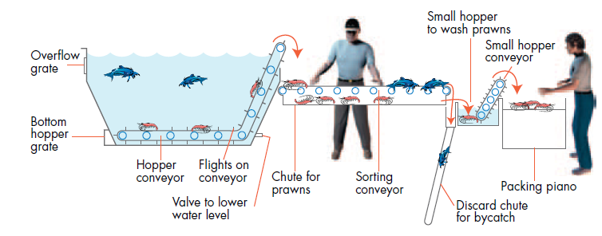
In most cases, the fitting of a hopper is not simply a replacement or modification of fishing gear. A hopper is effectively a tank, and its installation may have implications for the vessel’s structure, stability, electrical systems and fire safety arrangements.
For this reason, fitting a hopper is likely to trigger Marine Order 503 Schedule 1, item 6(f)(vii). Where this trigger applies, an existing vessel would become a transitional vessel and must undergo initial survey against the relevant transitional standards.
- More on Fitting hoppers to fishing vessels
Key areas to consider
Where a hopper is fitted, there are four main areas that may need to be addressed, in many cases the vessel may already be compliant.
1. Fixed fire extinguishing system
The installation may require the vessel to be fitted with a fixed fire extinguishing system in accordance with NSCV Part C4.
Even if there is some uncertainty about whether NSCV Part C4 applies, fitting a compliant fixed fire extinguishing system is generally good safety practice. This is particularly the case for older fishing vessels where machinery spaces and fire risk may not have been reassessed for some time.
Modern aerosol systems can be effective and relatively simple to retrofit to an existing vessel. They can provide a practical safety improvement, even for an existing vessel that is not otherwise required to comply with NSCV Part C4.2. Stability assessment
The fitting of a hopper will affect a vessel’s stability. This may be due to:
- the weight of the hopper
- the weight and movement of its contents
- changes to deck loading
- changes to the way the vessel is operated after the modification.
A stability assessment should be considered early in the planning process, before any modification work begins.
This is particularly important for existing vessels that do not have a current stability book, or where the vessel’s condition and arrangement may have changed significantly over time. In some cases, the vessel may no longer comply with its original stability assumptions.
Taking hull measurements early as part of the planning process before the hopper is fitted allows stability to be properly considered before significant work is undertaken. Early assessment can help avoid costly delays or unexpected compliance issues when the vessel is ready to return to operation.
3. Electrical safety
A certificate of electrical safety will be required. This should include confirmation that residual current devices (RCDs) are fitted and operating in accordance with AS/NZS 3000.
Electrical safety is not only a marine survey consideration. Fishing vessels are also workplaces, and electrical safety is an important part of meeting broader workplace health and safety obligations.
Where electrical equipment, wiring, controls, pumps, sensors or related systems are installed or altered as part of the hopper fitment, the electrical work should be appropriately assessed and certified.
4. Navigation communication equipment
If the vessel becomes transitional, its navigation and communication equipment may need to be upgraded to meet the applicable requirements of NSCV Part C7B and C7C. Whether upgrades are required will depend on the vessel’s existing equipment fit out.
Owners and surveyors should consider these requirements early, as equipment upgrades can affect costs, installation timeframes and certification planning.
Planning the work early
The key message is that fitting a hopper should not be treated as a minor or like-for-like change to fishing gear without thorough consideration.
As a hopper is effectively a tank, its installation is likely to trigger transitional vessel requirements under Marine Order 503. Owners, builders and surveyors should identify this early and thoroughly consider the implications before the modification work is commenced.
Early engagement can help avoid delays, unexpected costs, or the need to reassess work after it has been completed. This can also build confidence for owners, particularly where there are concerns about the implications of a vessel becoming transitional.
Although the modification may require upgrades to other systems onboard the vessel, the result should be a safer vessel with modern fishing equipment, improved operational efficiency and stronger assurance that the vessel remains fit for its intended service.
A hopper can be a practical and useful addition to a fishing vessel, but it is still a significant modification. Recognising this from the start will lead to better safety outcomes and a smoother certification process.
Ultrasonic thickness measurement of metallic vessels is now available
AMSA has published DCV-ITS-021 – Ultrasonic Thickness Measurement of Metallic Hulls.
This instruction provides guidance on AMSA’s preferred method for undertaking ultrasonic thickness measurement of metallic hulls, including steel and aluminium vessels, as part of renewal survey activity. It covers matters such as survey preparation, safe access, equipment, selection of measurement locations, minimum extent of testing, reporting requirements and acceptance criteria.
DCV-ITS-021 is now ready to be used by accredited marine surveyors in the conduct of surveys. Surveyors undertaking, witnessing or relying on ultrasonic thickness measurement should familiarise themselves with the instruction and apply it where relevant to metallic vessels in survey.
Survey Matters — we want your suggestions
Survey Matters aims to be relevant and useful for accredited marine surveyors, boat builders, class societies, and others involved in the survey of domestic commercial vessels.
Readers are invited to submit topics or ideas for future articles that would be helpful to the industry. Please send suggestions to DCVSurvey@amsa.gov.au