
In this edition:
- Extensions of time for renewal surveys
- Guardrail requirements on Class 1 vessels
- B Extended vessels – remember the Class A requirements
- AMSA marine survey accreditation dedicated email address
- New marine incident data highlights key risks
- DCV service notations
- 10 yearly renewal surveys - internal inspection of fuel tanks
- Accreditation framework review
- Survey Matters - we want your suggestions
Extensions of time for renewal surveys
Make sure you remind vessel owners and operators of the importance of planning renewal surveys well in advance.
AMSA has observed an increasing number of larger domestic commercial vessels seeking extensions under Exemption 7 (Division 7) to allow sufficient time to complete an out-of-water renewal survey after the Certificate of Survey expiry date.
While recognising that surveyors are not responsible for operators' maintenance and fleet management arrangements, AMSA encourages surveyors to remind vessel owners and operators of the importance of planning renewal surveys well in advance. This includes securing slipway availability early enough to ensure all survey requirements can be completed before the certificate expires.
Early planning benefits everyone involved in the survey process. When vessels are slipped and surveyed within the normal renewal timeframe, surveyors are better able to conduct thorough inspections without the additional administrative burden and scheduling pressures associated with extension requests. Avoiding compressed timeframes also provides greater flexibility to identify, rectify and verify defects before certificate expiry, helping to support both survey quality and regulatory compliance.
With the number of suitable slipway facilities decreasing in recent years, proactive planning is becoming increasingly important to avoid delays, minimise the need for extensions, and support the continued safe operation of domestic commercial vessels.
Guardrail requirements on Class 1 vessels
Check that you are correctly interpreting requirements for guardrails in NSCV C1 6.4.
It has come to AMSA’s attention that there are different interpretations of the guardrail requirements for Class 1 vessels. NSCV C1 (2025) sets out the requirements for guardrails in Chapter 6.4. The requirements depend on whether the area is accessible to passengers.
- More on guardrail requirements
Decks not accessible to passengers
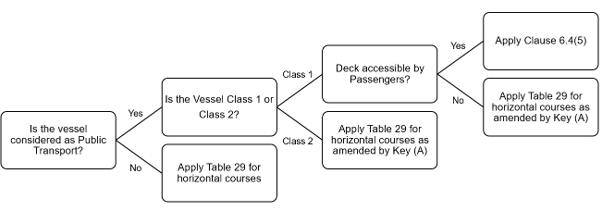
The keynote to Table 29 provides that, for vessels considered public transport, including Class 1 and Class 2 vessels, the maximum permissible opening between horizontal courses must not exceed 230 mm.
For a Class 1 vessel, this requirement applies to decks that are not accessible to passengers.
Decks accessible to passengers
Clause 6.4(5) provides an additional requirement for decks on Class 1 vessels that are accessible to passengers. Any opening in a bulwark or guardrail below the top rail must be arranged so that a 125 mm sphere cannot pass through the opening.
This requirement applies to the size of the individual clear openings below the top rail. It is therefore more restrictive than simply measuring the spacing between horizontal courses.
Example
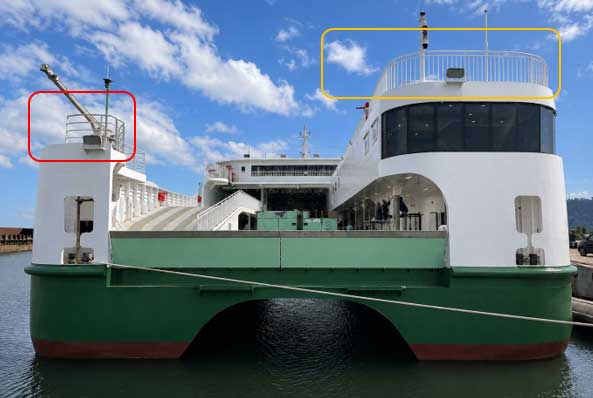
The image below shows examples of both arrangements on a Class 1 vessel:
- Port side (Red): This area is not accessible to passengers. The maximum permissible opening between horizontal courses is therefore 230 mm.
- Starboard side (Yellow): This area is accessible to passengers. The guardrail is therefore arranged so that no opening below the top rail allows a 125 mm sphere to pass through.
To assist in the decision-making process, the following can be used as guidance:
B Extended vessels – remember the Class A requirements
Reminder: Make sure that B Extended vessels are assessed against the applicable Class A medical stores requirements.
AMSA has recently identified some B Extended vessels where the medical stores required for their area of operation may not have been fully recognised.v
It is important to remember that B Extended is not simply an ordinary B operational area with an extended geographical limit.
NSCV Part B defines 1B Extended, 2B Extended and 3B Extended vessels as vessels that comply with the NSCV requirements applicable to their respective vessel class in unlimited domestic operations. In practice, this means that where a specific B Extended requirement is not provided, the corresponding Class A requirements apply:
- 1B Extended → 1A requirements
- 2B Extended → 2A requirements
- 3B Extended → 3A requirements
This principle has previously been highlighted in Survey Matters, including a number of areas where the requirements for B Extended vessels differ from those for ordinary B operations.
- More on B Extended vessels
Medical stores
Medical stores are one area where this distinction is particularly important. NSCV C7A Annex H specifies the medical equipment and supplies that must be carried according to vessel class and operational area. Table H.2 specifies Marine Order 11 as the applicable medical scale for Class 1A, 2A and 3A vessels operating in unlimited domestic operations.
Accordingly, the applicable medical scale for 1B Extended, 2B Extended and 3B Extended vessels is Marine Order 11, rather than the medical scale that would normally apply to an ordinary Class B vessel.
The current instrument is Marine Order 11 (Living and working conditions on vessels) 2024, which commenced on 23 December 2024.
Surveyors should therefore ensure that B Extended vessels are assessed against the applicable Class A medical stores requirements, including the carriage, condition, stowage and currency of the required medical equipment and supplies.
What about existing and transitional vessels?
The C7A safety equipment requirements are not limited to new vessels.
All vessels in survey, including existing vessels, are required to comply with the NSCV safety equipment standard that applies to the vessel, and specifically confirms that NSCV C7A applies to all Class 1, Class 2 and Class 3 vessels in survey.
The transitional arrangements previously provided in C7A for existing vessels have now run their course for medical equipment and supplies. Previous editions of Survey Matters highlighted that Marine Order 503 applies C7A to new, existing and transitional vessels and specifically identified the medical equipment and supplies in clause H3.2 as one of the requirements to be checked.
Therefore, new, transitional and existing B Extended vessels should be assessed against the applicable C7A medical stores requirements, unless an exemption, approved equivalent solution or other applicable provision modifies the requirement.
What about first aid training?
C7A also provides guidance regarding the competency of persons administering first aid. Clause H11 states that persons administering first aid should possess, as a minimum, a current first aid qualification in accordance with Marine Order 505. It also notes that some medical equipment and supplies may require additional training to administer safely.
Owners and operators should therefore consider whether the people expected to administer the medical supplies carried on the vessel have appropriate training. There may also be separate medical and first aid personnel requirements applicable under Marine Order 11 depending on the vessel's complement and operation.
Checking crew training is not the remit of a surveyor
The Marine Surveyors Accreditation Guidance Manual makes clear that the content of a vessel's Safety Management System is not a surveyable item. Crew training and induction procedures may be sighted and recorded as an SMS observation during a periodic or renewal survey, but those observations are not part of the survey and must not affect the surveyor's recommendation to the National Regulator.
Surveyors are therefore not required to verify crew first aid or medical training as part of the vessel survey. However, awareness of the requirements can be useful when discussing the medical stores with an owner or operator, or where a surveyor is asked what training may be appropriate for the equipment carried.
The key point
When surveying a B Extended vessel, do not simply apply the requirements for a Class B vessel.
For medical stores: B Extended → Class A requirements → Marine Order 11 medical scale.
This applies to 1B Extended, 2B Extended and 3B Extended vessels, including existing, transitional and new vessels in survey, unless an applicable exemption or equivalent solution provides otherwise.
AMSA marine surveyor accreditation - new dedicated email address
If you have an enquiry about accreditation, send it to dcvaccrediation@amsa.gov.au.
AMSA would like to advise of an update to the Marine Surveyor Accreditation function within AMSA.
Following changes to AMSA’s organisation structure, the Surveyor Accreditation team has transitioned to the Regulatory Strategy and Engagement team within the Regulation and Vessel Certification Branch. While our reporting arrangements have changed, the services we provide remain the same. Louise and Toulla will continue to administer the Surveyor Accreditation Scheme and will remain your primary contacts for accreditation matters.
As part of this transition, AMSA now has a dedicated mailbox for all accreditation enquiries: dcvaccrediation@amsa.gov.au
Please update your contact lists and use this email address for matters relating to:
- applications for accreditation
- accreditation renewals, variation and surrenders
- accreditation conditions
- panel interviews and assessments
- general accreditation enquiries
For other application, audit and survey related enquiries for domestic commercial vessels, please continue to use the existing mailboxes:
- dcvsurvey@amsa.gov.au for audit and survey enquiries
- dcvapplications@amsa.gov.au for vessel application enquiries
Using the appropriate mailbox will help ensure your enquiry is directed to the right team and responded to as efficiently as possible.
Thank you for your continued support. We look forward to continuing to work with you.
New marine incident data highlights key risks
In 2025, we received 4,174 marine incident reports. Operational shortfalls remain the main drivers of marine incidents.
The Marine Incident Annual Report 2025 provides a whole-of-fleet analysis of marine incidents across domestic commercial vessels (DCVs), foreign-flagged vessels (FFVs) and regulated Australian vessels (RAVs).
In 2025, we received 4,174 marine incident reports. Operational shortfalls, particularly in vessel control and navigation, and technical failures remain the main drivers of marine incidents.
The impact on people remains significant. DCV marine incidents resulted in 4 fatalities, 228 injuries (including 44 serious injuries), and 92 people overboard incidents, up 19% from 2024. Across RAVs and FFVs, a further 206 injuries were reported, down from 298 in 2024, with serious injuries also decreasing. While this reduction is encouraging, crew injuries remain a key concern, particularly during routine tasks such as maintenance, operational access, and cargo and stores handling.
These findings reinforce that many incidents occur during routine operations. Strengthening onboard practices, system reliability and crew safety controls remains key to reducing risk. Every report contributes to a clearer understanding of industry risks and helps shape future safety initiatives.
Explore the report for more insights.
DCV service notations
Did you know: You can use service notations in Certificates of Survey (COS) and Load Line Certificates (LLC) to quickly identify the NSCV requirements against which a vessel has been assessed.
On some recently issued Certificates of Survey (COS) and Load Line Certificates (LLC), you may have noticed NSCV service notations such as those highlighted in the image below.

- More on service notations
Service notations defined in NSCV
These service notations are defined in the National Standard for Commercial Vessels (NSCV) for Class 1, Class 2 and Class 3 vessels, but not for Class 4 vessels. The former USL Code did not include service notations.
Service notations provide a concise way of identifying the NSCV requirements against which a vessel has been assessed. They provide a useful reference for future surveys, modifications and marine safety inspections by helping to identify the requirements currently applicable to the vessel and whether a proposed change to the vessel or its operation may affect its current service notation.
How are the service notations assigned?
The service notations shown on the certificate represent the highest service category assigned to the vessel on its Certificate of Survey. They are determined in accordance with the relevant provisions of the NSCV.
Service notation Where specified in the NSCV Accommodation Level This notation identifies the accommodation level of the vessel, being AL72+, AL36-72, AL 12-36 or AL≤12, as assigned in accordance with the Table 4 of NSCV C1 (2018) or Table 3 of NSCV C1 (2025). Fire Risk Category This notation identifies the vessel's fire risk category, being Category I, II, III or IV, as assigned in accordance with Table 2 of NSCV C4. Flooding Risk Category This notation identifies the vessel's flooding risk category, being Category I, II, III or IV, as assigned in accordance with Table 2 of NSCV C6B. Hull and Scantling Notation This notation identifies the construction standard used for the design and construction of the vessel's hull and superstructure.
This could be a standard specified in Table 1 of NSCV C3 such as Class Rules or an ISO standard, or other standard used under a Generic Equivalent Solution (GES), for example AS 4132 under GES 2010/02.
Transitional vessels
For transitional vessels, newly issued certificates may also include service notations. Where a vessel continues to comply with the USL Code, the service notation may be similar to the example shown below.

Ten-yearly renewal surveys – internal inspection of fuel tanks
Make sure you conduct an internal inspection of a fuel tank, even if an inspection hatch is absent.
AMSA audit activities continue to identify instances where fuel tanks are not being internally inspected during the 10-yearly renewal survey because the tank is not fitted with an inspection hatch. Surveyors are reminded that the absence of an inspection hatch does not remove the requirement to conduct an internal inspection.
- More on fuel tank inspection requirements
The requirement
Clause 4.11(2)(g) of SAGM Part 2 requires an "internal fuel tank inspection of at least half the number of the tanks on board" at every second renewal survey, which should occur at intervals not exceeding 10 years and six months unless otherwise approved by the National Regulator.
This requirement applies to all vessels and is not dependent on vessel class, construction material, or fuel tank size.
Where confusion has been identified
A common misconception is that smaller fuel tanks, particularly those with a capacity below 800 litres, do not require internal inspection because they are not fitted with an inspection hatch.
While NSCV C5A requires tanks greater than 800 litres capacity to be fitted with an inspection hatch, the survey requirement is separate from the construction requirement. The requirement to conduct an internal inspection applies regardless of tank size, construction material or whether an inspection hatch is fitted.
What is expected
Where a tank is not fitted with an inspection hatch, the surveyor should consider appropriate methods to gain sufficient visual access to assess the condition of the internal surfaces. The method adopted will depend on the vessel and tank arrangement. This may include the removal of fittings to improve visibility, the use of a borescope, or other suitable means that allow the surveyor to form an opinion regarding the condition of the tank.
The purpose of the inspection is to assess the integrity and condition of the tank's internal structure and surfaces. Surveyors should consider signs of corrosion, pitting, contamination, coating deterioration, cracking, deformation, or other defects that may affect the tank's continued serviceability. Where adequate access cannot be achieved, surveyors should carefully consider whether sufficient evidence is available to support a recommendation regarding the tank's condition.
A word on safety
Safety must remain the primary consideration when conducting internal tank inspections.
Fuel tanks may present hazards including flammable vapours, oxygen-deficient atmospheres, and confined-space risks. Surveyors should ensure appropriate precautions are taken before any inspection is undertaken. Depending on the circumstances, this may include tank cleaning, purging, ventilation, gas testing, isolation of ignition sources, and compliance with applicable confined-space safety procedures.
Recommended next steps
Although inspection records are not generally required to be submitted to AMSA, maintaining photographs and other supporting evidence is considered good practice and may assist in demonstrating the basis for survey decisions. This may be particularly useful in the event of audit.
Surveyors are encouraged to review the requirements of SAGM Part 2 Clause 4.11 and ensure that internal fuel tank inspections are being completed as part of every 10-yearly renewal survey, including for tanks that are not fitted with dedicated inspection hatches. If you encounter a vessel arrangement that you are unsure how to inspect safely, please contact dcvsurvey@amsa.gov.au before commencing the survey. Seeking advice early can help identify an appropriate approach and avoid the need to address issues after the survey has been undertaken.
Accreditation framework review
We will consult accredited surveyors on proposed outcomes before undertaking broader public consultation. Be ready to have your say.
AMSA is reviewing the Marine Surveyor Accreditation Framework to ensure it remains clear, practical and fit for purpose as the industry evolves. The framework has been in place since 2015, during which time vessel designs, technologies, materials and operating contexts have continued to change.
Over the past 12 months, an Industry Reference Group (IRG) of accredited surveyors has tested the current framework against practical survey experience. The discussions covered categories, tiers, standards, conditions, renewal, continuing professional development (CPD), professional associations, audit, guidance, regulatory decision-making and the boundaries of the surveyor role.
The discussions identified areas where the framework can create uncertainty or unnecessary complexity. Key issues included:
- how categories, conditions and scope limits are understood
- how specialist functions and emerging areas of practice are treated
- how vessel owners can identify a surveyor with the appropriate accreditation
- whether accreditation settings adequately reflect differences in vessel complexity, survey activities and operating contexts.
Workforce sustainability was also a key focus. The IRG considered entry standards, pathways into the profession, renewal and currency requirements, and how surveyors develop and demonstrate capability over time. Discussions also considered how the framework can maintain professional standards while recognising different backgrounds, supporting career progression and responding to regional coverage and workforce pressures.
The review also considered the obligations that apply after accreditation, including CPD, professional association membership, insurance, recordkeeping, conflicts of interest, defect communication and recommendation timeframes. The focus was on supporting accountability and confidence in survey outcomes without creating requirements that are unclear, impractical or disproportionate.
Surveyors also highlighted the need for clearer and more accessible guidance, particularly for complex or recurring issues and for older, modified or transitional vessels. Audit and assurance arrangements were considered in terms of technical credibility, consistency and proportionality, as well as the need for communication that supports improvement and regulatory confidence.
AMSA is also considering how any future reform could be implemented. This includes the treatment of existing accreditation, experience and capability, as well as the timing, sequencing and transitional arrangements needed to minimise unnecessary burden and uncertainty.
Policy development is underway and no decisions have been finalised. AMSA will first consult accredited surveyors on proposed outcomes before undertaking broader public consultation. This staged approach will help test whether any proposed changes are practical, proportionate and workable, including the implementation and transitional arrangements that would be required.
AMSA thanks the members of the IRG for their time, expertise and considered contributions to the review.
Survey Matters suggestions
AMSA wants to make sure Survey Matters is relevant and useful for accredited marine surveyors, boat builders, class societies, and others involved in the survey of domestic commercial vessels.
We encourage our readers to submit subject requests or ideas to DCVSurvey@amsa.gov.au for articles that would be of assistance to industry in future publications.