
Showing 121 - 140 of 1127 results for WA 0852 2611 9277 Anggaran Dana Untuk Membangun Plafon Gypsum Tile Murah Kota Bekasi
- NP-GUI-004: National Plan learning from pollution incidents and exercisesRead about the general arrangements for post exercise and incident reviews.Last updated: 03/18/2024
- NP-GUI-013: National Plan oil spill dispersant effectiveness field test kit operational guideInstructions to operators on how to undertake an effective test of possible dispersants.Last updated: 03/18/2024
- NP–GUI–017: National Plan activation of the fixed wing aerial dispersant capabilityGuidance for the AMSA Duty Officer responsible for either placing on standby or activating the fixed wing aerial dispersant capability as part of a pollution response.Last updated: 03/18/2024
- NP–GUI–018: National Plan national maritime places of refuge risk assessment guidanceWhen dealing with vessels in distress or in need of assistance there is, at times, a requirement to find an appropriate location where necessary steps can be taken to prevent an escalation of eventLast updated: 03/18/2024
- NP-GUI-020: National Plan Australian Government coordination arrangements for maritime environmental emergenciesThe Australian Government coordination arrangement for maritime environmental emergencies provide a framework for the coordination of Australian Government departments and agencies in response to aLast updated: 11/28/2024
- NP–GUI–007: National Plan coordination of international incidents: notification arrangements guidanceArrangements to apply where a maritime environmental emergency impacts upon the interests of another country.Last updated: 03/18/2024
- NP-GUI-012: National Plan technical guidelines for preparing contingency plans for marine and coastal facilitiesClear technical guidance to the operators of marine and coastal facilities for the preparation of marine pollution contingency plans and for establishing and maintaining an effective response capability.Last updated: 03/18/2024
- NP–POL–004: National Plan register of oil spill control agents for maritime response useUnder the National Plan for Maritime Environmental Emergencies, only those spill response chemicals, or oil spill control agents, listed on the National Plan register of oil spill control agents caLast updated: 03/18/2024
- 2021 monthly domestic commercial vessel incident reportsThe information you provide in your incident report plays an important part in guiding the way we improve maritime safety for everybody on the water. By reporting marine incidents to us, you are also meeting your reporting obligations under Australian laws.Last updated: 05/09/2022
- 2022/02 — Proper stowage and securing of cargo containersThe purpose of this notice is to remind vessel owners, operators and masters of:Last updated: 05/19/2025
- NP–GUI–025: National Plan response, assessment and termination of cleaning for oil contaminated foreshoresStructured guidance for identifying when to stop the response to a maritime environmental emergency.Last updated: 03/18/2024
- 2022/13 — Guidance document for the recording operations in the oil record book part IThis marine notice advises of the availability of guidance for the recording of operations in the Oil Record Book Part I – machinery space operations (all ships), prepared and issued by the International Maritime Organization (IMO).Last updated: 01/10/2025
- Templates for a safety management systemThe templates can be used to help you in developing or reviewing your SMS.Last updated: 04/07/2025
- Dispersant responseChemical dispersants are one of the response tools available during oil spill responses.Last updated: 03/07/2025
- Maritime safety informationAMSA and the Bureau of Meteorology provide vessels with maritime safety information (MSI) about hazards and foreseeable dangers to safe navigation through Australia's marine environment.Last updated: 12/21/2023
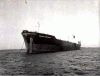 Princess Anne Marie, 14 July 1975On 14 July 1975 the Marine Operations Centre in Canberra was alerted that the oil tanker Princess Anne Marie had sustained a large crack in its hull approximately 300 miles off Western Australian.Last updated: 11/09/2020
- How to register an oil spill control agentApply for acceptance on the oil spill control agents register.Last updated: 11/11/2024
- Construction - C3Constructing the hull, decks, superstructures, deckhouses and bulkheads.Last updated: 11/07/2024
- Freedom of Information disclosuresThe FOI disclosure list describes the documents disclosed under the Freedom of Information Act, and the date of disclosure.Last updated: 11/26/2025