Showing 121 - 140 of 613 results for WA 0852 2611 9277 Biaya Bikin Plafon PVC Lebar 30 Cm Murah Makasar Jakarta Timur
- NP-GUI-012: National Plan technical guidelines for preparing contingency plans for marine and coastal facilitiesClear technical guidance to the operators of marine and coastal facilities for the preparation of marine pollution contingency plans and for establishing and maintaining an effective response capability.Last updated: 03/18/2024
- Intergovernmental agreement on the National Plan to combat pollution of the sea by oil and other noxious and hazardous substancesThis agreement sets out the plan for how Australia will respond to marine pollution spills in Australian waters.Last updated: 03/27/2023
- NP-GUI-016: National Plan maritime discharges of oil and oily water during emergency and response situationsDischarges into the sea from a vessel of oil, oily water, decant water, or water emanating from an oily water separator is strictly regulated under Australian maritime law.Last updated: 03/18/2024
- NP–POL–004: National Plan register of oil spill control agents for maritime response useUnder the National Plan for Maritime Environmental Emergencies, only those spill response chemicals, or oil spill control agents, listed on the National Plan register of oil spill control agents caLast updated: 03/18/2024
- NP-GUI-001A: Use of National Plan equipment by states and the Northern TerritoryHow to hire National Plan equipment and conditions of use.Last updated: 03/18/2024
 Changes to national law general exemptions from 1 July 2025: check your eligibilitySeveral national law general exemptions have been reissued for a period of 3 to 5 years with changes. Check if you need to reapply for your exemption, and that you still meet eligibility requirements.Last updated: 07/02/2025
 Supporting essential workers delivering essential servicesDuring the COVID-19 pandemic many seafarers have played an essential role.Last updated: 05/03/2022
- NP–GUI–025: National Plan response, assessment and termination of cleaning for oil contaminated foreshoresStructured guidance for identifying when to stop the response to a maritime environmental emergency.Last updated: 03/18/2024
- Kirki, 21 July 1991On 21 July 1991 Greek tanker Kirki lost its bow off the coast of Western Australia, resulting in a major pollution incident.Last updated: 11/09/2020
- Exemption 02 - Marine Safety (Certificates of survey)This exemption is for owners of certain vessels who may not want to obtain a certificate of survey, or comply with certain conditions on a certificate of survey.Last updated: 12/12/2025
- 2022/02 — Proper stowage and securing of cargo containersThe purpose of this notice is to remind vessel owners, operators and masters of:Last updated: 05/19/2025
- Map of Torres Strait Zone - Schedule 1 - ExemptionsThis map displays the specified area in relation to the Torres Strait zone.Last updated: 06/30/2025
- Maritime safety informationAMSA and the Bureau of Meteorology provide vessels with maritime safety information (MSI) about hazards and foreseeable dangers to safe navigation through Australia's marine environment.Last updated: 12/21/2023
- 2022 monthly domestic commercial vessel incident reportsThe information you provide in your incident report plays an important part in guiding the way we improve maritime safety for everybody on the water. By reporting marine incidents to us, you are also meeting your reporting obligations under Australian laws.Last updated: 04/05/2023
- Energy efficiency design measureThe Energy Efficiency Design Index (EEDI) is a mandatory measure that promotes the use of energy efficient (less polluting) equipment and engines on new build ships.Last updated: 07/17/2025
- 2021 monthly domestic commercial vessel incident reportsThe information you provide in your incident report plays an important part in guiding the way we improve maritime safety for everybody on the water. By reporting marine incidents to us, you are also meeting your reporting obligations under Australian laws.Last updated: 05/09/2022
- Greenhouse gas emissions from international shippingIn 2023, the International Maritime Organization (IMO) adopted a revised strategy on reduction of greenhouse gas emissions from ships.Last updated: 11/17/2025
- Western Australia fuel oil suppliersFind local suppliers of fuel oil in Western Australia.Last updated: 11/19/2025
- Survey standards for domestic commercial vessels in-surveyAll domestic commercial vessels under the national law are required to meet design, construction, stability and equipment standards.Last updated: 10/30/2025
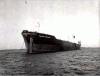 Princess Anne Marie, 14 July 1975On 14 July 1975 the Marine Operations Centre in Canberra was alerted that the oil tanker Princess Anne Marie had sustained a large crack in its hull approximately 300 miles off Western Australian.Last updated: 11/09/2020